Thursday, July 19, 2012

Recent Flowers, Butterflies and 2 Sphinx Moths

The Common Buckeye Butterfly is not so "common" in Central New York

It’s been a very dry summer so far. In fact, like much of the country, here in Upstate New York we’ve been experiencing a moderate drought. Still, life at the nature preserve goes on and the season's procession of blooming wildflowers and their visiting insect pollinators continues.
The Wildflower meadow is dominated by Gray-headed Coneflower
As our wildflower meadow’s spiderwort plants finally run out of blossoms, the ground becomes dominated by Gray-headed Coneflower and Bergamot. This Coneflower’s blooms are pale yellow and the plants themselves are quite tall with thin foliage that no doubt helps them to be drought resistant. Indeed, they show little sings of stress as thousands of them wave to and fro in the hot breeze.

The Northern Broken-Dash Skipper feeds on Bergamot

Only about half as tall as the coneflowers, the Bergamot is a real insect magnet. If you scan any grouping of these pale blue flowers you’re likely to see a variety of butterflies and bees working diligently on them. The tubular flowers of Bergamot are especially compelling to any creature with a long proboscis.
Clouded Sulfur Butterfly on Oxeye
The small skipper butterflies are more common this year than they have been for the last 5. The Bergamot seems to really bring them out at this time in the summer. Several varieties of tiny dark skipper like the Dun Skipper, the Northern Broken-Dash and the Little Glassywing seem to be the most common. 2 days ago, a Common Checkered Skipper was seen for the first time in several years. Aptly named, this species shows bold white checkered markings that make it easy to identify.

Hummingbird Sphinx Moth hovers over Begamot as it feeds
Some moths are also visiting the flowers, including the Hummingbird Sphinx Moth (also called the Hummingbird Clearwing). This moth’s behavior closely resembles that of a hummingbird; its rapidly moving wings and its ability to precisely control its flight –to hover and fly backward, invites the comparison. This unusual moth is only one member in the family of Sphinx Moths. The others share similar feeding behavior, but unlike the day-active Hummingbird Moth, these related species only become active after the sun sets.
The Pandorus Sphinx Moth at rest on the garage floor
The amount of eyeshine alone tells of this moth's noctural habits
I had a recent encounter with a Pandorus Sphinx Moth. One evening last week, one flew into our garage when I was coming back from walking our dog. The moth was confused by the inside light and it flew rapidly around the ceiling, noisily bumping against it. Its body was impressively large –about the size of an actual hummingbird. I turned off the inside light and I spent some time trying to get the disoriented creature back outside, but it seemed intent on continuing its battle with the ceiling.


At one point I shined a flashlight on it and was amazed by the amount of reflection that came back from its eyes. Obviously, this is a moth that is well geared for low light conditions. Eventually, the moth did settle down on the floor and I was able to capture it and release it outside –seemingly undamaged by the ordeal.

Eastern-tailed Blue Buttefly
Compass Plant are the tallest both above and below the ground

The incredibly tall Compass Plants have started to bloom along the meadow’s edge. This perennial sunflower has finely cut leaves that are a little fern-like. It’s likely that this adaptation helps the plant from losing moisture. Also, the leaves have a rough texture which aid in the retention of water. The roots of the Compass Plant grow astoundingly deep  –likely yet another adaptation to dry conditions. You would expect no less from a plant that evolved in a prairie environment. The Compass Plant flower is like a smaller version of a typical annual sunflower bloom, but usually with lighter yellow petals.
Royal Catchfly

Royal Catchfly has also begun to bloom on the other side of the meadow  –where the meadow meets Wick’s Pond. From a distance its brilliant red flower could be mistaken for Cardinal Flower, but it’s no relation. However, the Cardinal Flower’s relative, Blue Lobelia, is growing nearby at the shore of the pond, but it’s nowhere close to blooming at this point in the summer.
A female Ruby-throated Hummingbird visits Culver's Root growing in the meadow

Sunday, July 15, 2012

The “Tropical” Birds of Our Local Forest


The male Scarlet Tanager perches below the forest canopy 
Many of the birds nesting at our nature preserve only reside with us from 3 to 4 months out of the year. The rest of their lives are spent in the tropical regions of Central and South America. While they are here with us, in a way, they bring the tropics to us in the form of their colorful plumage and exotic songs. Though many of these “neotropical” songbirds breed in a variety habitat types, the forest, or forest edges are the most common places to find them.
The male Rose-breasted Grosbeak sings from a treetop on the forest edge

At the nature preserve, our older forest is the most likely place to see or hear these birds. The most well-known tropical looking birds –the Scarlet Tanager, Rose-breasted Grosbeak and Baltimore Oriole are somewhat easier to see at this point in the season, as most are involved in feeding their young, which are now out of the nest. As you get close to them, they give sharp alarm calls, and fortunately for the observer, defensive parents will sometimes come in close to scold intruders.
The male Baltimore Oriole perches on a Red Oak in one of the reforestation fields

A male Hooded Warbler protecting his nest area
The Hooded Warbler nests in the brushy understory of our open-canopy  forest. The male of the species truly does look like a refugee from the tropics with his bright yellow body and black hood, which is interrupted by a bold yellow eye mask. His song is a strongly whistled short phrase that sounds to some like: “ta-weet…ta-weet…ta-weety-o”. This song varies little with different individuals, but the Hooded Warbler also sings an alternate song which is not as well recognized and is harder to translate into words.
The female Hooded Warbler with an insect to bring back to the nest

The Hooded Warbler most often breeds in small colonies where there is a substantial amount of suitable habitat. We are fortunate to have one such colony at our nature preserve.


The male Hooded returns to the nest where hungry chicks await
After the young leave the nest, only one infertile egg remains

As a nest site, the female chose a short Beech sapling that was shrouded by blackberry brambles. Only by getting very low to the ground, was I able to peer between the leaves and see what she was up to. That’s where I saw her weaving together relatively wide strips of bark and long pieces of grass. It really more resembled the nest of a Red-winged Blackbird than any creation by a member of the warbler clan. When finished, the sturdy looking nest looked like it would stand up well to any boisterous brood, and as things turned out, it did.


The male Mourning Warbler on the breeding grounds
Another, mostly tropical species, the Mourning Warbler, has almost exactly the same habitat requirements as the Hooded Warbler –nesting in the understory of open-canopy forests. This is another Yellow bird, but this one has a complete black hood over its head with no yellow eye mask. In male birds, the hood is darkest at the point where it meets the bird’s breast.

A female Mourning Warbler fluffs up her feathers and takes a sun bath
The species is shy and retiring –that is unless you get close to their active nest (most always hidden away in a low bramble), at that point both parents come out to scold you with harsh “witch…witch..witch” calls. It’s almost as if they are trying to accuse someone of practicing the dark arts.

The not very tropical looking Ovenbird
The song of the Mourning Warbler is a rapidly given phrase. It’s a series of 3 or 4 tight, almost gurgled trills, which are terminated by a low note. The male Mourning Warbler can sometimes be heard to give a rather extraordinary “flight song”. As is implied, the flight-song is given on the wing as the bird ascends over his breeding grounds. This song is very seldom heard –and there seems to be very little mention of it in the bird literature.  It sounds like a haphazard jumble of notes with the Mourning Warbler’s typical song incorporated into the middle of it. It can be compared to the evening flight song given by the Ovenbird (another warbler of the forest) and that given by the Common Yellowthroat. The latter species’ flight song is the most familiar to birders, since it is given at all times of the day in forest clearings and brushy meadows.
The male Common Yellowthroat or "Bandit Bird"

Monday, July 9, 2012

The Beavers of Secret Pond

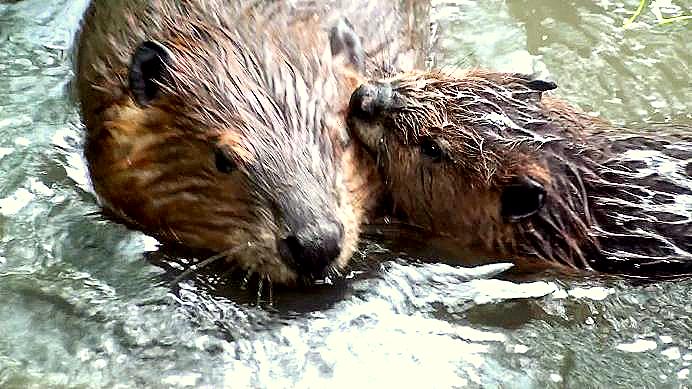
3 of 4 new beaver kits chew on willow leaves with their mother in the background

Following the disastrous dam rupture at our main beaver Pond, our beaver colony moved downstream to a practically invisible and inaccessible pond, aptly named Secret Pond. Ever since, I have been trying to ascertain the health of the colony and it has proved to be somewhat of a challenge. In short, I have not been able to confirm the presence of several of the adults including May Apple –the colony’s patriarch. In my last post on this subject (dated June 24th), I was convinced that I had seen him working on one of the new dams, and I even captioned one of the pictures with his name, but I’ve since concluded that I had actually seen Blueberry, May Apple’s  2-yr old son, who resembles him in many respects.

A new kit playfully harasses its older brother -- Badger

As I mentioned in that previous post, the disaster had brought the season’s new beaver kits out of the lodge a little prematurely. I now know that there are a total of 4 new kits. They are quite small, but they are clearly eating solid food and are well adept at diving through the lodge’s underwater tunnels. In fact, the youngsters enjoy a large degree of independence around 2 ponds where they play, explore and generally harass each other and their adult kinfolk. 
2 kits wrestle with each other at Secret Pond

The beavers’ work at Secret Pond and at 3rd Pond has managed to bring the water levels up to respectable levels. Through dam building and dredging, the deep water areas have been expanded at the 2 ponds, thus enabling the beavers to more easily transport their construction materials to where they are needed. Also, the entrances to the 3rd Pond’s lodge are now submerged, which will make it much harder for intruders to enter.
A Green Frog sits on the rock right next to me

Much of the other pond dwelling wildlife have now moved from the upstream disaster zone to the newly restored ponds. Ducks, fish, frogs, dragonflies and even Whirligig Beetles are all in residence now. The more closed in and shaded complexion of Secret Pond attracts shyer species. Songbirds like Tanagers, Towhee and Thrasher sometimes sing from branches at the water’s edge. Veery, Kingbird and Baltimore Oriole also call while hunting for the insects –many of which are also attracted by the water.
A Brown Thrasher sings near the water' s edge

The nature experience at the bank of this pond is a quite intimate one. While sitting on the shore, it is easy to be completely immersed in the activities of the wildlife –the beavers are right there –only a few feet away. The birds sometimes fly right in front of my face and even occasionally attempt to land on me. Damselflies actually do land on my legs, and I often have a Green Frog sitting beside me as I scribble down notes on the beavers.

Mother Julia comes on shore to chew on some greens
The beavers I’m seeing regularly are the colony’s matriarch –Julia; also Blueberry, Badger (one of 4 kits that were born last year) and all 4 of the new kits that were born this spring. There may in fact be more beavers in residence, but if there are, they are not venturing out in the afternoon or evening, and I have seen little evidence suggesting that any other beavers are contributing work to their various construction projects.

Julia and Blueberry engage in mutual grooming --it's a beaver thing to do
Blueberry and Badger seem to be the primary workers now. They are most frequently seen collecting materials (some of which comes from the remnants of several destroyed dams) and using them to fortify the dam at Secret Pond –and to a lesser degree, the dam at the 3rd Pond. Unlike May Apple, these 2 young adults take more frequent breaks to eat, groom and interact with family members. May Apple in comparison was the consummate workaholic, he rarely took breaks and compulsively switched from one task to another.
 
The lodge at 3rd Pond is now occupied, if not exactly fixed up
The beavers may be working on a new bank lodge at Secret Pond, but I haven’t been able to confirm that, since the entire pond is not visible from my lookout’s perspective.

Meanwhile, a portion of the impressive crater that was once our largest beaver pond has already begun to turn green with plant sprouts. Grass seeds as well as a variety of other plant seeds that have lain dormant in the mud are taking advantage of this opportunity to grow. If the beavers continue to leave this pond’s dam in disrepair, this pond basin will quickly transform into a beaver meadow. The rich silt that collected at the bottom of the pond facilitates a fantastic growth rate of plants; so within a month, a lush meadow will be growing were beavers once swam.
Grass starts to sprout in the muddy basin of the old main pond

Don’t think that the beavers don’t know this. They are herbivores and they often feed on grass. At some point the beavers will return to repair the dam, and when they do, much of this grass will be submerged. The beavers can then safely harvest it –one bite at a time. 
A beaver kit reaches out for an Aspen leaf

Friday, July 6, 2012

Breeding Birds

We have a persistent presence of Turkey Vultures throughout the breeding season
Evidence of breeding birds is not necessarily confirmed only by finding a bird at its nest. It can also be inferred by observing certain bird behavior. First, the mere presence of a bird on a given territory during the breeding season is an indication that the bird is possibly nesting in the area. Birds that persistently defend territory –sing or give alarm calls in the same location for more than a week, are providing us with evidence that they are probably breeding there.

Brown Thrashers are frequesntly found at the Preserve during the nesting season


Positive breeding evidence short of finding the active nest or parents feeding fledglings includes seeing a bird with a fecal sack in its bill. Fecal material is generally removed from the nest site by the parent songbird; so if a parent is seen in the act of taking out the trash, breeding is confirmed.


The male Indigo Bunting protects his unseen young
On the basis of the above criteria, I can get a good idea of what birds are breeding around our nature preserve or for that matter, any other place that I visit regularly. I know that we had at least one pair of Indigo Buntings raising young at the preserve this summer. I saw no nest or young birds, but I did see both parents vigorously defending about 6 square yards of territory. Seeing both parents with their beaks occasionally packed with food and giving alarm calls was strong evidence that they were feeding young fledglings in the nearby bushes.

The Common Yellowthroat was also defending his young
Close by the buntings, a pair of Common Yellowthroats were behaving in a similar manner –issuing sharp alarm calls and frantically guarding some unseen offspring. The Yellowthroat is probably the easiest member of the warbler clan to find in the Northeast, but seeing their nest is not so easy. They build on or near the ground and most often under a tangle of vegetation. Unfortunately, they tend to raise more than their share of cowbird nestlings, so evidently, the female cowbird doesn’t have any trouble locating the Yellowthroat’s nest.


The Clay-colored Sparrow may be our newest nesting songbird species
This year, on the north side of the nature preserve, we’ve hosted a small colony of Clay-colored Sparrows. This is of particular interest to me since the species has never spent the breeding season with us before, and there are no known breeding colonies in our region. Consistent singing and holding territory for over a month leads me to the conclusion that they are likely nesting, but I have yet to obtain any proof positive on that score.


A parent Red-eyed Vireo defends its territory from marauding Jays
As I’ve mentioned in a previous post, seeing which songbirds pursue or “mob” nest predators (like Jays, Grackles and Crows) entering a given territory is a good indicator of what species are breeding in the area. Watching Red-eyed Vireos getting exercised over a marauding Blue Jay told me that the vireo had an active nest nearby.


The male Rose-breased Grosbeak on the breeding territory
Seeing birds mate or collect nest material also counts as positive evidence of a species breeding, though not always a guarantee of their subsequent breeding success. Recently while taking tour group through our old woods, we had the good fortune to have a pair of Rose-breasted Grosbeak land on a low branch right in front of us on the trail and proceed to mate. Mating is a very quick affair with songbirds, but it was proof that the species had plans, and likely already had already built a nest somewhere nearby.
The Black-billed Cuckoo is nesting somewhere nearby
The other day I saw a pair of Black-billed Cuckoo traveling together through the young trees growing along one of our brushy meadows. Seeing a pair together suggests the possibility that the species is breeding, but when one of them was seen to have a stick in its bill, proof positive was at hand that the birds were starting to nest. European Cuckoos don’t generally build their own nests, but in this part of the US, our 2 species (Yellow-billed Cuckoo and Black-billed Cuckoo) typically do.


An immature and flighted Baltimore Oriole still beggs to its parents
Hearing begging calls of nestlings or fledglings is another way to confirm breeding. Though the similar vocalizations given by many young birds make it difficult to distinguish which species they belong to, some do give quite distinctive calls. This season, Baltimore Orioles seemed to have had a bad year; far fewer nests have been seen than usual at our preserve and in the region. However, I have been able to determine that the species has had some breeding success, and this is largely by being able to recognize the begging calls of Oriole fledglings. Those Oriole begging calls sound a little like “Tu – tu – tu – tu”, which is often repeated.

Monday, July 2, 2012

4th of July Butterfly Count

White Admiral Butterfly --only one was found during our survey
Every year during the last week of June, a couple of us locals participate in the Annual Butterfly Count. This nationwide survey (plus Canada and Mexico) is sponsored by the North American Butterfly Association. The Butterfly Count is patterned off of the National Audubon Society’s Christmas Bird Count which takes place annually in mid December. In fact the 15 mile diameter count circle that we use for the Butterfly Count is precisely the same one that we use for our local Christmas Bird Count.
15 Silver-spotted Skippers were seen on the day of the butterfly count


The objective of the Butterfly Count is to spend a day counting every butterfly that we see in an assigned area within the count circle. We note each species and number of individuals found. We also keep track of our time in the field and how many miles we cover while counting. All of the collected information will go into a database that will help conservationists understand more about the health of butterfly populations and their species' distribution throughout the continent.

2 Dun Skipper were located during the count
Unlike the bird Count, the butterfly count’s exact date is not selected far in advance. Inclusive are any dates in June or July. The Count is generally known as the 4th of July Butterfly Count since most of the leaders that run the individual counts choose a date near the July 4th holiday. Our own count has traditionally been run in the last week of June.
14 Great Spangled Fritillary were seen -most were at the nature preserve


For the day to be productive we need to pick a warm, relatively cloudless and windless day –all conditions favorable for the maximum butterfly activity. Normally the count day is selected just a few days ahead of time so that the weather forecast is more accurate. The truth is if you choose a cold rainy day, you might as well stay home, because no butterflies will be flying.

The Hickory Hairstreak  - 3 were found at the nature preserve
My counting territory is largely restricted to our nature preserve, while the count leader takes his own well-established route that samples a larger part of the good butterfly habitat in our count circle. The leader and founder of our count is Ernest Williams, a Hamilton College Professor and nationally known butterfly expert.

A Striped Hairstreak Butterfly drinks from Milkweed flowers 
On Thursday, I found 28 butterfly species at the nature preserve and a total of 223 individuals. We collectively found a total of 591 butterflies representing 32 differnt species. The most common species was the Cabbage White–a nonnative. The Cabbage White almost always attains the 1st or second most common status on our count, and I suspect on many other counts conducted throughout the country.


15 Baltimore Checkerspot Butterflies were located  -all in wet meadows


Not nearly so common, the Baltimore Checkerspot, one of my all-time favorite butterfly species, was located in our nature preserve’s boggy wetland. The wetland is populated by the plant called turtlehead, which is the Checkerspot’s main food plant. There I found only one adult, but Ernest located 15 checkerspots in a wetland a few miles to the north. This species had become hard to come by for the last several years, so we were pleased to see that they finally seem to be having a good year.

19 Monarch Butterflies were found -this male is feeding on Milkweed


In a normal year, the Milkweed Plants are just beginning to bloom during the last week of June, but this year the blooms of milkweed, as well as many other field plants, were much more advanced. This meant that there were a lot more flowers than usual to check for butterfly visitors.

Monarch Butterflies were well represented at the nature preserve this year. Most were found in meadows filled with their hostplants (Common Milkweed) and some were seen laying eggs on those plants. In early successional fields where young willow seedlings are common, the Monarch’s smaller lookalike, the Viceroy Butterfly, was found. No surprise, the Viceroy’s foodplants are trees in the willow family.
16 Questionmark Butterflies were seen during the count

Acadian Hairstreak Butterflies also lay their eggs on Willow, but this year I found none of that species anywhere at the preserve. However, during the course of the morning, I did find 3 other species of hairstreak butterfly, including the Hickory Hairstreak, Banded Hairstreak and Striped Hairstreak.


10 Eyed Brown Butterflies found in our boggy wetland


Restricted to the habitat of our boggy meadow was a decent sized population of Eyed Brown butterflies –these guys turned out to be the only representatives of their species found on our count. The caterpillars of Eyed Brown Butterflies feed on sedges, which grow plentiful in that particular wetland.


9 Red Admiral were found during our count, but I expect more to emerge any day now
The Red Admirals that were so plentiful earlier in the early spring were found only in small numbers by both of our teams in the field. I suspect the numbers of this species will be increasing any day now, as the progeny of those original migrants begin emerging from their chrysalises, which are no doubt hidden away in wooded recesses throughout the region.

Friday, June 29, 2012

Singing the Wrong Song


At the nature preserve - a Feild Sparrow belts out the typical song of his species  

You might think that sometimes birds are deliberately trying to deceive you, but really, it could just be the way that they were raised.

A male Prairie Warbler sings at the preserve in 2011


In 20 years of identifying birds by their songs, I have been fooled many times. I recall being deceived by a Field Sparrow that instead of singing the typical Field Sparrow "bouncing ball" song, he performed a perfect rendition of a Prairie Warbler's song. Interestingly, the normal songs of the 2 species are not in the least bit similar. The Field Sparrow's song is a series of clear whistled notes that become increasingly short as it progresses (hence the bouncing ball effect). The Prairie Warbler, by contrast, sings a toneless song that consists of short buzzy notes given in a rapid volley.

One thing that these 2 unrelated birds have in common is their habitat, which is overgrown pasture land. It is thought that during a particularly impressionable time in his development, a juvenile songbird can be greatly influenced by the songs of other birds that are nesting in his immediate neighborhood. So it’s possible to imagine a young Field Sparrow, that instead of growing up to sing his father's traditional song, rebels and proudly belts out some kind of bohemian rhythm –like that produced by the freewheeling warblers in the next bush over. That's the way to break your father's heart, boy!
Who are you to tell me I'm singing the wrong song?
Well, probably not, but trying to secure a mate of your own species when you’re not speaking the same language is at best problematic. It’s likely that a female Prairie Warbler would be as confused as I was when she gets a gander at who is singing. And a female Field Sparrow would have no incentive to even get close enough to find out that this confused soul is one of her own kind. However, it has been shown that birds with aberrant songs can succeed in holding territories and even securing mates of their own species.

The Golden-winged Warbler that sang the wrong song for 5 years

For about 5 consecutive breeding seasons we had a male Golden-winged Warbler at the nature preserve that sang exactly like a Blue-winged Warbler. This is more understandable than the former case with the Field Sparrow, since the Golden-winged and Blue-winged are so closely related, and In fact the 2 species regularly interbreed. Their standard songs are also quite similar and the notes are of a similar pitch and quality. The Golden-winged Warbler sings (typically) 4 hearty buzz notes, while the Blue-winged’s song consists of just 2 buzzy notes.

A male Blue-winged Warbler
Most recently we’ve had an Eastern Towhee whose song is very strange indeed. To me it sounded ever so vaguely like a Red-winged Blackbird’s song, and definitely nothing like a Towhee’s normal song (often characterized by the phrase: “Drink… your… tea”.) Based only on the habitat that I was hearing the song emanate from, I had thought it possible that a Towhee was producing the song, but I couldn’t be sure on the identification until I actually saw the bird singing.
This Eastern Towhee will not be having any tea this morning


In this case, I don’t think the Towhee had been influenced by neighboring birds to sing this aberrant song. I think it’s more likely that this bird’s syrinx (voice box) is not working properly. Or maybe this is just his far out interpretation of the classic Drink...your…tea. Hey, it’s also possible that he just might not want any tea.
His rendition may ultimately catch on. Perhaps someday in Central New York, all of the Towhees will sing like him –and the great towhee tea boycott will begin.

Unlike most female songbirds, the Female Northern Cadinal does sing

Regional accents occur with some bird species. A resident Cardinal singing in New York State may not be singing precisely the same song as its cousin in Michigan. Regional accents can be even more local. For years I noted a peculiar sounding alarm call given by Baltimore Orioles living around the Utica Marsh and Mohawk River floodplain area. Orioles in other parts of the County, though they give an equivalent alarm call, do not give the same calls as their lowland counterparts.
The male Baltimore Oriole