Sunday, July 21, 2013

The Plight of Bobolinks and Other Grassland Birds

The male Bobolink gives warning calls from a bush overlooking the meadow
In recent decades, in our region and generally in the northeastern US, grassland birds aren't fairing very well. Much of the agricultural land is now being planted with row crops like soy beans and corn and is in effect, no longer viable as breeding habitat.  Maintained hay fields are pretty much ideal for their nesting, but unfortunately, too often these fields are mowed too early in the season for the birds to finish their nesting cycle. In other words, the birds are unable to fledge young before their nests are destroyed. This phenomenon has made grassland birds some of the hardest to find species in the rural areas where they once thrived.
A group of male (Tom) Turkeys feed in a recently cut hay field
Savannah Sparrows are becoming less common due to early mowing
This year there was somewhat of a reprieve for a few grassland species that nested in local fields. The massive amounts of rain that fell during June (at the height of the breeding season) necessarily delayed the first cutting of many hay fields. This meant that the nests begun on time, most likely were able to produce young. That's assuming that parents were able to secure enough insect food for their nestlings, which is not always  easy during periods of persistent rain.
A Savannah Sparrow with a beak full of insects for its nestlings
Decades ago, the Eastern Meadowlark was a common grassland bird in the region
Savannah Sparrows, which seem to be the latest grassland species to suffer serious population declines in our region, did apparently manage to complete their nesting cycle in the hay fields just west of the nature preserve. This is the first time in years that I can say that. Bobolinks too seem to have been beneficiaries of the rains. 
A group a male Bobolinks gather in early July - they may be "refugees"
Hopefully, someday our grassy wildflower meadow will be used by Bobolinks
In recent years one of our preserve's meadows have played host to bobolink refugees. These birds were forced to abandon their nests once the tractors came onto their breeding grounds. The Bobolinks will not try to nest again, but will linger in the habitat for a few weeks before pushing into other areas with better food supplies. In only a month or so they’ll be starting to migrate south.
Gray-headed Coneflower begins to bloom in the wildflower meadow
As the habitat grows in it with bushes and small trees it attracts the Field Sparrow
Bobolinks still nest in the nature preserve's north field. This fallow field, which is only half on our property is just barely acceptable as breeding grounds for the Bobolink. The grass is giving way to goldenrod, asters and other tough stemmed perennials.  Certainly, the meadow as it is wouldn't even be considered viable nesting grounds by other grassland species. Most of them are much more particular than the Bobolink is about the make-up of the meadow's plant community.  
Increasingly, the Blue-winged Warbler is found in and around the Bobolink's field
The Rufous-sided Towhee is another bird that prefers brushy meadows
Now the Bobolink field is also slowly growing in with trees and shrubs. Every year there are more birds moving in that prefer brushier terrain to nest in. One of the Bobolink's new neighbors is the Clay-colored Sparrows, which were first identified as using this habitat only last year. This species along with the Field Sparrow, Blue-winged Warbler, Rufous-sided Towhee, Brown Thrasher and Alder Flycatcher will all benefit from the evolution of this habitat. 
The Clay-colored Sparrow is a very uncommon breeders in the region

Sunday, July 14, 2013

Turtle and Crayfish Refugees & Recent Butterfly Wars

Painted Turtles were common refugees following recent flooding
Following the floods of June and early July, some of our nature trails were transformed into streams and a few were even began to be used as avenues by wetland denizens. Most often I was finding turtles –most of which had presumably been dredged out of their lairs by rushing flood waters.
A painted Turtle swimming in the pond after its release
A Crayfish was a most unexpected traveler on the foot trail
The most interesting refugee was a large Crayfish that I noticed purposefully trotting down the trail. It was heading away from the traditional streambed, so I scooped it up and carried over to one of the ponds. I had previously done this with a half-dozen turtles and so I expected no intrigue.  I thought that it might be nice to video the Crayfish release –just a simple shot of it walking into the pond, but we both got more than we bargained for when a large Green Frog hopped out of the grass, intercepted and engulfed the crustacean in its gaping mouth!
Walking a few short feet to the pond - expecting no trouble
A Green Frog comes out of nowhere at nabs the Crayfish!
After the frog lets it go, the Crayfish, unharmed, settles into its new home
All 3 of us were surprised, including the Frog, who upon seeing me, immediately relinquished his prize and dove back into the water. The Crayfish, looking no worse for the experience, quickly sought refuge beneath a submerged bed of algae. Somebody got their money's worth from their suit of armor today!
 
A Banded Hairstreak - ready for battle
The rival Banded Hairstreak 
I've witnessed several pitched battles between butterflies in the past week. So much for the idea of butterflies as symbols of peace and coexistence. In fact many butterfly species can be quite combative.  
The Acadian Hairstreak has been uncommon at the Preserve in recent years
Most often male butterflies fight over territory and access to females. That was the motivation behind a battle between two male Banded Hairstreak Butterflies. It was a remarkable contest –2 nickel-sized butterflies chasing and colliding with each other for bouts lasting at least several minutes. I wondered how these minute insects could imbibe enough nutrients in order to allow such a sustained energy output, but they managed it. The next day, what I presumed were the same pair were at it again. Noteworthy is the fact that I saw neither contestant feed while I observed them on both days.

 
The Common Woodnymph Butterfly is well camouflaged on my camera bag
The purpose for the fight was to allow the victor exclusive rights to the territory --and the right to proposition any female that happens by. After his rival had vacated the area, the champion hairstreak seemed to briefly turn his attention to me. And yes he did try to drive me out of the territory, but fortunately for me, after a few minutes, I just merged with the terrain and became like an oddly shaped snag.
 
One of 3 Northern Pearlyeye Butterflies - just itching for a fight
A few meters away on the same trail, 3 Northern Pearlyeye Butterflies were fighting it out for possession of another prime piece of real estate. These guys are generally weaker fliers than the hairstreaks, and they did take more frequent rests. But their breaks were short, and soon all 3 were at it again. Since the Pearlyeyes are larger butterflies, it was much easier to follow all of the action in their little war.
Silver-spotted Skipper - the largest skipper in our region
The Little Glassywing is one of the "3 Witches"
We have 3 species of tiny dark skipper butterflies that are difficult to identify without getting a very close look at their wings, and since the 2 that were fighting it the meadow were a constant blur, I had little hope of getting a solid ID. These similar species are sometimes referred to as the “3 Little Witches” and they include the Dun Skipper, Little Glassywing and Northern Broken-Dash.
The Dun Skipper is most often the darkest of the 3
With wing shapes that resemble fighter jets, these diminutive insects can attain relatively impressive speeds; indeed, there is no lackadaisical fluttering around with these guys. As you might imagine, it’s hard to clock the speed of a darting insect that changes direction so frequently, but some estimates have them reaching around 30 MPH.
Eastern tailed Blue Butterflies have been more common lately
The skipper battle that I was watching was much more of a high speed chase, than a fight and I didn’t perceive any physical clashing. They would each alight briefly on meadow plants, but not long enough for me to positively identify them – perhaps tomorrow.
Baltimore Checkerspot Butterflies are starting to fly in the wet meadows 

Sunday, July 7, 2013

The Beaver Meadow

A new grassy meadow grows in the basin of a former beaver pond
Typically, when beavers abandon a pond, the habitat quickly regenerates into meadow. Grass seeds and the seeds of many other plant species begin to sprout in the rich silted-up soil, and within a few weeks a lush sea of grass grows where once beavers swam. The beaver meadow continues to evolve; that is as long as beavers refrain from re-flooding the area. The first year, not much diversity will be encountered and the meadow is dominated by grass and only a few other easily perceptible plant species, but only a year later, plant diversity increases tremendously and a wildflower meadow is born.
 
Blue Vervain plants grow plentifully in the beaver meadow 
The old beaver dam is covered with wildflowers
Undoubtedly, many of us recognize the good work that beavers do by creating water impoundments –and therefore wetland habitat for scores of other creatures, but few of us give them credit for their gardening work. Even without a beaver meadow, a beaver dam can act as a raised garden –hosting thousands of blooms along its span and providing food resources for hummingbirds and butterflies as well as a source of forage and bedding material for muskrats and for the beavers themselves.
Square-stemmed Monkey-flower grows in the new meadow
Swamp Candles (or Yellow Loosestrife) is in the Primrose family
When our old farm fields are left alone to evolve as they will, most in our region become dominated by goldenrods and asters as well as alien invasives like spotted knapweed. These plants generally attain a lock on the habitat and will not easily be displaced. They will certainly not be nudged aside by any less aggressive flowers. In other regions of the country, fire acts a disturbance factor in the environment as it clears an area of its dominant plants and allows a new plant community to develop. In our area, it's the beavers introduce the disturbance factor and are therefore the fathers (and mothers) of distinct meadow types in a given environment.
Yellow Moth Mullein is in the snapdragon family
Northern Willow-herb has very small blooms
The succession of plants that colonize the beaver meadow are surprisingly different than those which dominate our adjacent old fields. A lot of this difference is by chance, since it depends on what plant seeds are inherent in the given environment. But in my experience new beaver meadows even in the same area will not all develop in the same way. This may be explained by the varying prevalence and reproductive success of local plants on a year-to-year basis.
 
A Northern Pearly-eye Butterfly at the meadow's edge
The first Hickory Hairstreak Butterfly of the season
Plant make-up in the beaver meadow will continue to evolve as the years go by. The first 2 years or so, annuals and biennials might make up a greater proportion of the meadow's diversity, but in subsequent years, perennials will become established and eventually  dominate –at least up until the meadow is re-flooded and transformed into a pond once more.
Not a beaver meadow - but our main wildflower meadow, now dominated by spiderwort
A small proportion of the spiderwort flowers are pale blue
Oddly enough, this year the meadow that once was home to Sarah's Pond is now hosting an outstanding bloom of Moth Mullein. Just where all those Mullein seeds came from is a mystery. I've never seen more than a few of these plants in the surrounding fields for the past dozen years. It’s conceivable that these seeds, along with those from dozens of other diminutive species were there all along, lurking in the silt at the bottom of the pond –biding their time and waiting for their chance to sprout.
 
A buck lays down and remains partially hidden in a corner of the field

A Spring Azure Butterfly (very small) lands on my shoulder 
Blue Vervain, which dominated the beaver meadow last season is back again in a big way this year. The copious amount of rainfall that we've received in the last several weeks have suited them fine, and they are growing taller than usual, and mingling well with the tall mulleins.

Sunday, June 30, 2013

A Word on the Recent Flooding and Then: Hairstreak Deception Display and the Eight-spot Forester

One of the preserve's brooks transformed into a raging torrent
The day I'm writing this, our region is experiencing a flood of historic proportions. A single storm dumped over 3 inches of rain on an area that was already super-saturated by previous heavy rains. Local flood damage is considerable and at the nature preserve, many of the trails and access roads have been damaged. So far our main beaver dam is still holding, but it is undergoing great stress from streams swollen beyond what they had ever been in living memory.
Many of the preserve's footbridges were washed away
A couple of years ago, a less extreme event was referred to as our one hundred year flood. So I guess this must be our 200 year flood!? I'm sure to devote a blog post to this significant event soon, but for now it's back to the regularly scheduled post:
Spring Azure Butterfly
Last month it looked as though we were starting to have a good butterfly season, but then a turn in the weather (toward the extremely wet side) would seem to have effectively suppressed their numbers. Fortunately the season is still young and there remains time for their numbers to bounce back. 2 butterfly species that emerged this week were the Eyed Brown and the Striped Hairstreak. At the preserve, the Eyed Brown is common in only one wet meadow where that butterfly’s main food plants sedges, grow plentifully. They are medium-sized butterflies and they are weak fliers –never flying very high over the vegetation and frequently stopping to perch.
Eastern Tiger Swallowtail
The Eyed Brown Butterfly only breeds in one wetland on the property
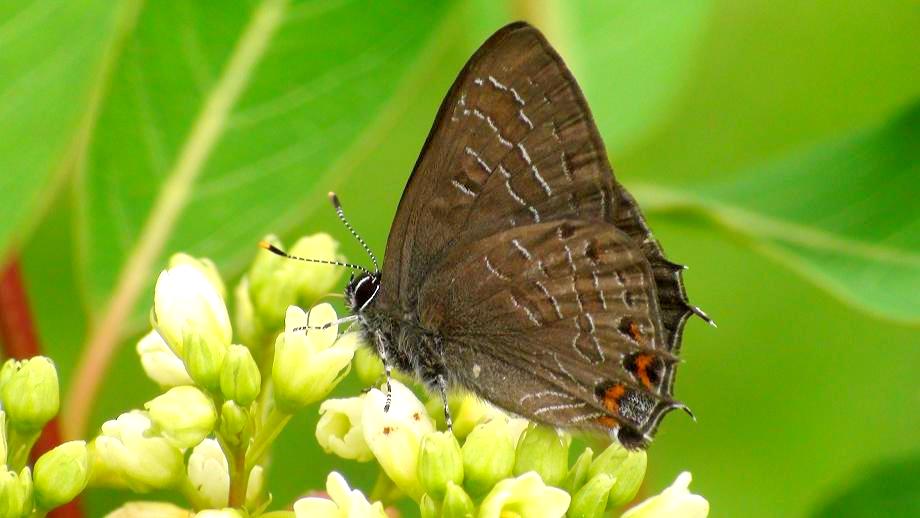
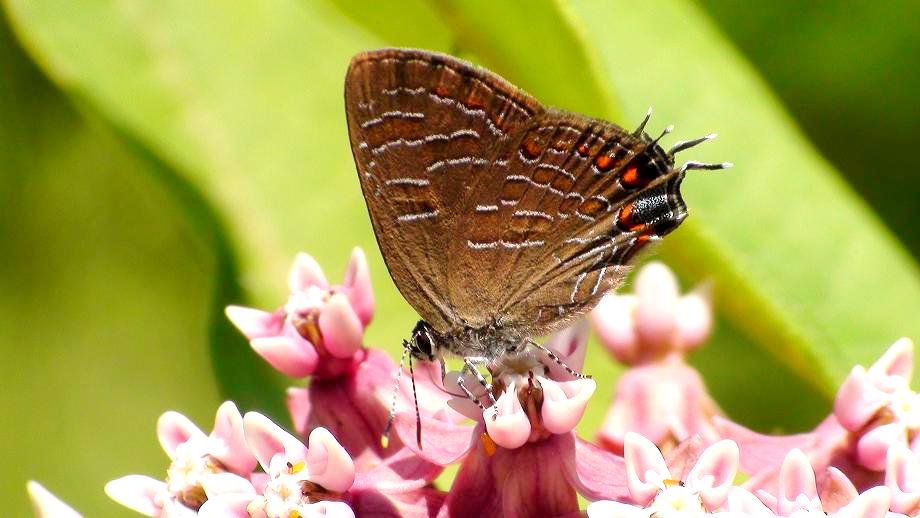
The Striped Hairstreak is one of 5 species of hairstreak that we have cataloged on the property. All of these species are small and easy to overlook. The Striped Hairstreak that I came upon today was feeding on nectar from Indian Hemp flowers, which have themselves only now just begun to bloom.
A Striped Hairstreak Butterfly on Indian Hemp flowers
A close up on the Hickory Hairstreak's false eye and antennae 
I'm not sure if it was on account of my presence or the presence of a bee on an adjacent flower, but the hairstreak was in full defense mode. With its wings kept closed over its back (a standard posture for a hairstreak butterfly) the insect was alternately lifting one hindwing and then the other, thus making  the hair-like projections at the base of its tail go up and down. It is surmised that the hairstreak does this in order to deceive would-be-predators into believing that the hair-like projections are the moving antennae of a more formidable insect.
Striped Hairstreak on Common Milkweed flowers
Mourning Cloak Butterflies are starting to show up just lately
The eye spots, which are also located at the base of the hairstreak’s hindwing, assist in creating the illusion that the creature’s tail is actually its head. Since predators (usually birds) most often target what they perceive to be a insect’s head – in the case of the hairstreak, instead of issuing a fatal blow, they end up with merely a mouth full of tail, and the hairstreak can usually slip away. With only a chunk missing from its hind-wing, the butterfly would be alive and quite probably still flight worthy.
The Eight-Spotted Forester Moth on a Ninebark Bush
2 foresters face-off on the same flower
The first Eight-spotted Forester Moths were found visiting our incredible Ninebark bushes. These day-flying moths are medium sized, black and have 4 large pale yellow spots on their forewings and 4 large white spots on their hindwings. They also have distinctive orange scaly projections on their legs. The caterpillars of this species are quite colorful - they are white and orange with many black bands and black spots. The larva feed on wild grape and Virginia Creeper - 2 plant species that we have plenty of.
The White Admiral is becoming more common in recent days
A pair of White Admirals spend some quality time on animal droppings
A picture destined not to be included in any butterfly calendar
White Admiral Butterflies are on the move just lately –though nothing remotely like influx of Red Admirals that we all experienced in the spring of 2012. I've been seeing White Admirals primarily following the roadways, which is an inherently dangerous behavior that results in many of them ending up as road-kill. Most of us think of beautiful butterflies nectaring on equally beautiful flowers, but in fact they will also readily drink from muddy puddles or even lick rocks on occasion. Not infrequently I'll discover them happily imbibing moisture (or presumably something of value) from animal droppings. It doesn't always make for the prettiest pictures, but it is interesting!