Sunday, October 20, 2013

The Spring Farm Beavers Prepare for Another Winter


Julia swims in to grab a poplar branch
She swims back toward the lodge with her prize in tow
Over the last month Spring Farm's beaver family has been collecting and storing branches in their underwater food cache. This year work on the cache was started a little later in the season than normal, but not nearly as late as in some years. Its tempting to make a correlation between how early beavers start assembling a cache, how large that cache is, and how severe the coming winter will be. Do the beavers have some foreknowledge that we lack? Are they able to tailor their provisioning based upon intuition? My guess would be - probably not. According to my observations, sometimes a large cache would be assembled in fall, and then the winter that followed turned out mild. Other years the cache was smaller and then harsher winter conditions led to the beavers to exhaust their supplies before the ice fully retreated from their ponds.
The upstream area where beavers are currently logging
The view looking back at the back at the beaver pond from the logging zone
The beavers do their tree cutting in late evening or early morning hours
Interestingly, food cache size isn't always indicative of the size of the colony that will be drawing from it. Food cache size seems to have more to do with how ambitious the individual food collector are - and of course, how many edible trees are available for cutting. Also the number of beavers actively collecting food makes a difference in the size of the cache. Not all beavers in a colony will be food collectors. In our colony, it’s usually the adult male that has taken on the primary role of procuring food, with 2-year old offspring also playing a not insignificant part. The adult female will also contribute, especially if there are no adult males or near-adult offspring. This year our colony is very much reduced from what it was last year. We now only have the adult female (named Julia) and 3 of her offspring from 2012. So far as I can determine, it seems to be primarily the yearlings that are collecting food for the cache, but Julia is also doing some of the heavy work.

The food cache is placed in front of the lodge - it looks like a partially submerged brush pile
It often takes many successive nights of work to cut a single large tree
The tree was cut through but then got hung up in the branches of other trees
An overnight wind storm brought the tree now - and now it's time to move it
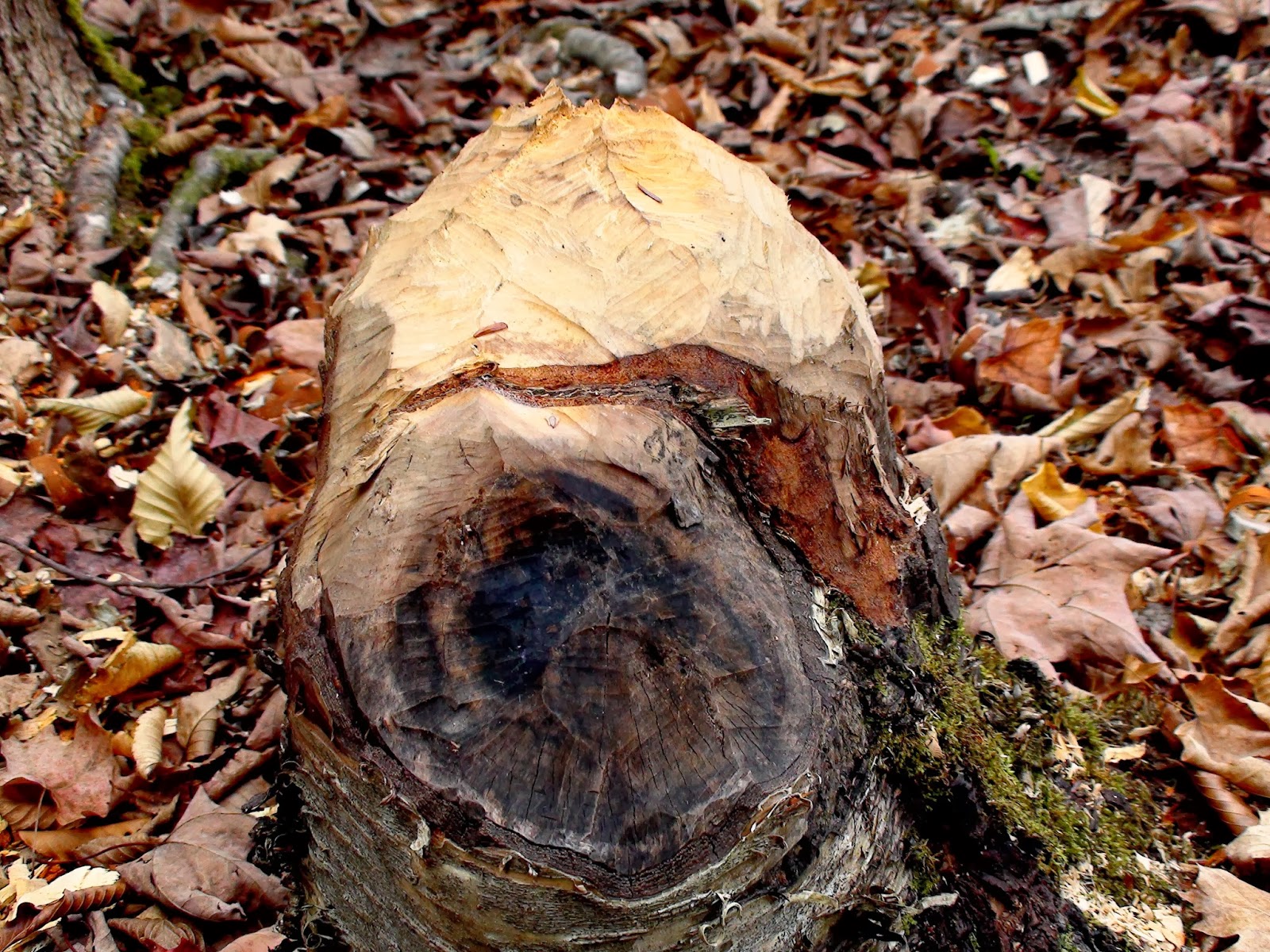
Over the last few weeks I've had the trail camera set on an area just upstream from the beaver ponds. Here the beavers have been actively cutting down trees. Their main targets are medium sized Yellow Birch trees that grow right along the stream-side  but they are also taking Sugar Maple and White Ash saplings. The work they do takes place after sunset, with the most activity taking place between 11:00 PM and 3:00 AM. Smaller trees may be taken down in a matter of minutes, but when dealing with larger diameter trees, it often takes the beavers multiple nights and even weeks. With their amazingly sharp chisel-like teeth, they pry out chip after chip of wood until they create a large gash at the base of the tree. Sometimes, a trunk will be chewed completely through, only to become lodged in the branches of neighboring trees. In a case like this, the beaver may need to cut through the trunk all over again, in an attempt to make the tree fall free.
Tree trunks are cut into sections to make them more manageable 
It's always easier when trees fall into the pond, but  some cutting is still necessary
One of the yearlings uses his weight to pull free a branch
Sometimes, the beavers are lucky, and the tree falls into the pond or across the creek. Wood that is already in the water is easier for them to deal with, but they are fully capable of wrangling branches and even tree trunks that fall very far from the water. They are adept at chewing off large branches and then using brute strength and ingenuity to pull them free from all obstructions. They will twist, turn and tug at a branch until it starts to slide and then they will do their best to keep up their forward momentum. Beavers are as tenacious as  any terrier, and they have a lot of weight, which they use to clever advantage. They will grab wood in their teeth, pull it upward and then use their weight to trust is forward. This might just get them a few inches, and they may need to alter their hold many times - anything it takes to move the piece further along. Trunk pieces that are too large to drag will be chewed into segments. Occasionally beavers will work cooperatively to move a large tree. I was hoping that my camera might pick up this behavior, but so far, no luck.
Is that a camera in that tree?
A Raccoon checks out the beaver's work
A Turkey Vulture visited the logging site one day
Beavers can be very quick in their reactions, and when it sounds like a whole tree might be coming down, all beavers make a fast dash to the water and to safety. They react in a similar manner when they sense a predator or hear any suspicious sound.
Beaver tooth etchings on a tree trunk
Beaver sculpture


Sunday, October 13, 2013

The Sparrows of October

The Fox Sparrow is our largest and reddest sparrow 
Note the dense pattern of spots on the breast
In October the number of migrant sparrows that spend time at the nature preserve can be pretty impressive. This year, given our excellent food reserves, it’s understandable that we’re hosting even more than usual. I think that the most commonly encountered species is now the White-throated Sparrow, and at just about every other hedgerow their spritely call notes can be heard. A few of the White-throats have even been singing their familiar whistled songs; however, minus spring levels of hormones, they sound a little weak.
 
White-throated Sparrows are migrating through in a big way
An adult White-crowned Sparrow stops at the post feeder
Song Sparrows are most common during the breeding season
I was crossing through one of our larger fields today and saw and heard many different kinds of birds there. The most common was the Myrtle Warbler – obviously not a sparrow. The Myrtle is the last of the warbler clan to migrate through in any number. Interestingly they were crossing the big field, traveling from bush to bush along with sparrows and kinglets. There were even several Swamp Sparrows in this upland field; you might think this a strange place for a wetland bird, but during migration most birds are not married to the same type of habitat that they require during the breeding season. They find food where they can while traveling.
 
The Myrtle Warbler shows patches of yellow on the side of the breast
During migration the Swamp Sparrow can be found far from any swamps
Field Sparrows have orange bills and show thin white eye-rings
The Lincoln’s Sparrow breeds in north country bogs, but during migration they too may be found in the scrubby growth at the borders of fields. They occasionally even show up in suburban yards at bird feeders. The Lincoln’s Sparrow is one of my favorite migrant sparrows; it’s very shy, but can usually be coaxed out into the open by making “spishing” sounds. When they do come out, they are always on guard and ready to dive back into cover at the slightest provocation. Their plumage is beautiful if subtle. They have a tight pattern of well defined streaks on their breast and flanks. The streaking has a light brown wash over it, which contrasts well with the bird’s clear white belly. They also show a thin white eye-ring that is surprisingly easy to discern even at a distance. Probably, if you look at Lincoln’s Sparrow in an identification guide, you might ask what the big deal is, but believe me, observing one in the field is always an exciting event.
Lincoln's Sparrow is the least common of the group of migrant sparrows
Even at a distance, Lincoln's Sparrow's well defined streaking stands out
During Summer, Field Sparrows and Song Sparrow nest in this same large field, and during migration it seems like they are still well represented. I didn't band them or anything, but I’m reasonably sure that the ones we are seeing today are not the same ones that bred here during the summer. These sparrows, like the other species that I've mentioned, breed in the north, and are now only using our nature preserve as migratory stopover habitat.
 
The White-throated Sparrow before a curtain of colorful sumac leaves 
A Palm Warbler stops to preen - note the bright yellow under the tail
I saw the first migrant Fox Sparrow of the season 2 days ago. First I heard its characteristic smack call, and then after a bit of “spishing”, I saw the magnificent bird himself. This bird is both the largest and the reddest of our sparrows. I’d also have to say that they give the loudest alarm call of the sparrow clan.
A Myrtle Warbler and a Palm Warbler forage in the Scotch Pine
This Scotch Pine was used by most of the birds that passed through the field
Our largest field is very slowly reverting to forest, and currently there are a few small trees as well as quite a few bushes scattered about. One particular tree – an 18 foot tall Scotch Pine, seemed to be serving as a convenient way-station for birds crossing over the field. At one time there were about 30 birds in that one tree – making it look something like a Christmas Tree decorated with very animate bird ornaments. At one point a White-crowned Sparrow was perched on the very top, while just below it, a group of Myrtle Warblers was actively flitting and foraging. The warblers were momentarily hovering and landing, walking on boughs and then plunging down – only to immediately shoot up toward the top again. As tiny as they are, the Ruby-crowned Kinglets were easy to follow, since they have a nervous habit of periodically flicking their wings while they systematically make their way around the tree. One lone Palm Warbler was also in the same tree. This bird constantly pumps its tail up and down in a rhythmic fashion. This makes the species an easy one to pick out of a crowd of otherwise dull plumaged fall warblers.
 
An immature White-crowned Sparrow perches near the top of the pine

Tiny Ruby-crowned Kinglets were flitting about in all directions
I wasn't the only one noticing all of the activity of the birds in and around this field. A female Northern Harrier flew in low over the field, passed within 15 feet of me and landed on a Bluebird nest box. The Harrier mostly feeds on small rodents, but one of these plump sparrows would also make a satisfactory meal. From her perch, the hawk peered at the hedgerow and toward the area where the most small bird activity had been taking place, but now it seemed like a ghost town. 
A female Northern Harrier stops by and breaks up the party

Sunday, October 6, 2013

A Shrew, a Vole and a Weasel - Oh yes, and a Killer Chipmunk

A Meadow Vole peeks out from one of many hiding places at the blind
I often get a nice variety of small rodents around one of our beaver dams. They come over to the blind in order to partake of the bird seed that I put down there. A few months ago, I wrote a blog entry about the Jumping Mice that were showing up at this same place after sunset. But while the sun is still up, it's mostly shrews and Meadow Voles that come. In fact there is a little Short-tailed Shrew scurrying around at my feet right now. It’s interesting to see how he varies his route over to the seed every other time or so. I imagine that he's trying not to be too predictable in case there's a predator watching - or someone with a camera.
The Short-tailed Shrew looks a bit like a gray furry bullet

 Including its short tail, the meadow Vole is about 5.5 inches long
There's probably not a prettier little animal than a Meadow Vole. They have a stout round look and a gentle mouse-like face  with round furry ears. They also have a rich brown coat with reddish highlights. On the other hand the Short-tailed shrew is a strange looking little being with very indistinct facial features - especially when viewed from directly above. In fact this animal looks a bit like a fuzzy bullet. They are uniformly silvery gray. They also have pointed faces that look like they have spent some time in a pencil sharpener. OK, so they are not that attractive, but I can just imagine what I look like to them. Actually, I suspect that to them, I look like a pair of shoes.
Both the Meadow Vole and the Short-tailed Shrew have relatively short tails
At 4 inches long with a 1"tail, the Northern Short-tailed Shrew is our largest Shrew
The diets of these 2 small rodents are for the most part quite different; while the Meadow Vole feeds on a wide variety of plant material, the Shrew eats mostly insects - some it will paralyze with its poisonous saliva and store for later use. Obviously both species appreciate sunflower seeds and peanuts. When they come to feed at the same time, it's obvious that the vole and the shrew don't get along very well and too frequently they become involved in yelling matches. They don't actually get into physical fighting, but they only sound as if they're going at it. Their vocalizations are very harsh. The sound is like something between an old door creaking and the noise made by handling Styrofoam. I'm not sure which creature is responsible for the bulk of this noise, but I suspect it's that shrew.
Looking a bit like a mouse herself, the Ermine or Short-tailed Weasel preys mainly on mice
There's a weasel on the move 
I just watched the Vole run off and this time it went right to the beaver dam and disappeared into a crevice.There are a million places for a mouse to hide out in in a beaver dam and that’s true for a beaver lodge as well. That's one of the reasons that predators like to hunt on beaver dams. Weasels like the Ermine and the Mink are particularly well suited for hunting on a beaver dam. Their extremely thin bodies allow them to enter some of the most narrow crevices and mouse burrows.
Later in the fall the Ermine will turn completely white except for a black tip on the end of its tail

Possibly the weasel was attracted to the site by the noise made by the shrew and the vole 
The female Short-tailed Weasel is between 5 and 8 inches long. The male is slightly longer
I saw an Ermine (AKA: Short-tailed Weasel) on the beaver dam a few days ago. She was threading herself through the piles branches and logs that make up the back side of the dam. At one point her attention turned to the blind. Evidently she must have recently seen or heard the small rodent activity that takes place there and so she thought she might try her luck at catching something. After comically popping just her head out of several different rotten logs near the blind, she finally got the nerve to run past me. She blasted over to the post where most of the seed is placed and quickly investigated all of the little nooks where the Chipmunks, sparrows and and mice scurry in and out from.
Weasels can fly? Well, not really, but they can jump pretty well
Another kind of weasel that hunts on the beaver dam is the Mink
I had a great view of this and thought that I was filming it, but alas, my camera was not set properly as so I taped a lot of nothing instead. At one point, she entered the bottom of a dilapidated bat house that I keep in the blind and use as a second tier seed tray. She climbed up through the slatted box and poked her skinny head out of a hole that some Red Squirrel had chewed through the side of it. It was then that a Chipmunk came on the scene. I thought, oh no, that poor little chipmunk is in for it now. Run for your life, little chippy! No, this great bull chipmunk ran right up into the weasel's face and sent it scrambling away with a flea in its ear (and no, not literally a flea). Now who expected that to happen!. Granted, a Short-tailed Weasel is about the same size as a Chipmunk - if skinnier and a little longer. All I can say to the Chipmunk is don't try that trick on the Mink - and positively don't try it on the Fisher!
Don't let this tough guy ever catch you in some dark back alley 
An immature Sharp-shinned Hawk is trying to scare up something on the beaver dam
The day after all of the weasel action, an immature male Sharp-shinned Hawk was seen hunting on the beaver dam. Sharp-shinned Hawks specialize in hunting birds for the most part, so what was he doing there?  Currently we are in the midst of a rather impressive sparrow migration and occasionally Song Sparrows and Swamp Sparrows hunt for insects on and around the beaver dam, so maybe these songbirds were what the Sharp-shin was interested in. Well, he never caught anything at that dam, but when he left he flew low over the stream and landed somewhere behind the next beaver dam. I guess that maybe this particular Sharp-shinned Hawk specializes in hunting on beaver dams. I should have warned him about the killer Chipmunk that lives here. 
Swamp Sparrows are occasionally hanging out on the dam these day

Song Sparrows are the most commonly occurring species near the beaver pond

Saturday, September 28, 2013

Raven Sightings Increase at the Preserve - Also, 2 Garter Snakes Found in a Bush


Sightings of Common Raven at the nature preserve have been on the increase
Over the last 3 years the number of Raven sightings at the nature preserve has been on the increase. I say sightings, but more often its their low pitched croaking call that is heard without anyone getting a glimpse of the bird itself. In New York State, I've always associated the Raven with the Adirondacks and with very large tracks of forest, but that seems to be changing now. In recent decades as forest replaces much of the farm land in the central part of the State, habitat opportunities for the Raven have improved. They also benefit from a reliable supply of carrion that is provided by frequent car/animal collisions. The Ravens are not alone in benefiting from that - vultures, coyotes, crows and many other opportunistic carnivores and omnivores can rely on supplementing their diet with fresh roadkill.
A reliable supply of road-kill helped Turkey Vultures expand their range northward 
Competition for food between Ravens and Vultures may explain the behavior that I witnessed 2 days in a row this week. Turkey Vultures have been in the process of migrating south for the past few weeks. However, lately when they sail over the nature preserve they can count on drawing a response from one or 2 Ravens. The Ravens, though around half the size of the vultures, don't seem to have any trouble escorting their potential competitors to a higher cruising altitude and thereby ushering them along on their migration. Nothing to feed on here, vultures. You just keep moving right along.
A Turkey Vulture soars out of range of the Ravens
Both Ravens return after the Vultures are ushered on their way
The Ravens are remarkably agile in the air - soaring, diving and rolling. After they showed the vultures to the aerial door, the 2 Ravens playfully spared with each other in the air. It was as if they were exhilarated by a job well done.
One raven tucks in its wings and dives into the path of its companion
 Ravens aren't happy about the vultures and this crow is not happy about the ravens
We may not have the ravens at the preserve for too much longer; as our over-wintering population of American Crow increases their presence, the Ravens will more and more become the focus of the crows’ ire. The crows, through sheer weight of numbers are able to effectively escort the Ravens to the periphery of their wintering grounds where they present little competition for food resources.
A large female American Toad perches on a large rock in the middle of a foot trail
At the preserve we’re starting to see the last of the reptiles and amphibians for this season. Soon all will retire to their winter quarters – whether that means burrowing down into the pond mud or retreating underground into a den. For now, many are still quite active as daytime temperatures are reaching up to 70 degrees F.
This Northern Two-lined Salamander was found beneath a rock at a woodland stream
Red Spotted Salamanders are still being found in the old woods
Some of the massive numbers of young toads that hatched at the ponds and emerged from the water in early summer are still being seen daily. In some places, it’s a challenge not to step on them. Red Spotted Salamanders are also fairly common in the old woods – and along the creeks both Slimy Salamander and Two-lined salamanders are still found.

2 Eastern Garter Snakes intertwined in a Honeysuckle Bush
Ever see a snake in a bush? I have a number of times. Usually they are not hunting, but appear to be coiled up and resting – perhaps waiting for the sun’s energy to warm up their cold-blooded bodies. One day this past week, I found 2 Eastern Garter Snakes together “sitting” about 3 feet high in a trail side bush. The 2 were tightly intertwined and at rest. They were not mating, but perhaps the second snake was lured to that unlikely spot by a pheromone trail laid down by the first snake. Probably the intention of the first snake was not to find a mate, but to find a companion that it could leech warmth from. Snakes sometimes do this in order to warm themselves up sufficiently to become active enough to hunt. They tend to do this on days when the sun’s warmth is not able to do the job alone.

It was a little hard to tell which snake head belonged to which snake body