Sunday, November 10, 2013

Preparing for the New Wildflower Meadow

A new wildflower meadow is on its way - Gray-headed Coneflower in bloom
During the last few weeks I've been collecting seeds in order to plant in a new wildflower meadow. This late in the season almost all of the nature preserve’s plants have produced their seed, but that doesn't mean that any of them want to give it up to me. Currently the seed heads of Brown-eyed Susan remain locked up tight and no amount of crushing seems to free them. On the other hand Gray-headed Coneflower couldn't be more obliging, and with just the smallest amount of pressure applied to the seed-head, all of the plant’s small dark seeds are released. 
Just the slightest pressure frees the seeds of Gray-headed Coneflower
An American Goldfinch helps itself to the ripe seeds of Tall Coreopsis
The seed heads of Virginia Mountain Mint are extremely aromatic
Virginia Mountain Mint in bloom
The seed heads of Purple Coneflower are protected with sharp spiky projections that can easily puncture a glove or a finger. In this way it’s a lot like a thistle. However, once you manage to free a few of its seeds the rest can be stripped off with no problem. The small seeds of New York Ironweed are all attached to their silky parachutes and they come off easily only when the parachutes are ready to deploy. 
The sharp spiky seed heads of Purple Coneflower are very thistle-like
Purple Coneflower will make many pollinating insects happy in the new meadow
The seed heads of New York Ironweed resemble little bottle brushes
New York Ironweed in bloom
Blue Lobelia is an easy plant to shake down for seeds and I do literally mean shake down. The seeds are held in tubular pouches are can easily be dumped and shaken into a container.  Bergamot seeds, like those of Lobelia are as small as pepper grains and are also easy to collect, but not if you take too long to get to them. Forsaken too long their seeds often get blown away before collection time. I missed out on collecting Spiderwort seeds since those plants produce their seeds much earlier in the season. Currently it’s difficult to find even an old dried stem of more than one of them in the old meadow where a thousand bloomed last summer.
Ohio Spiderwort blooming in the old meadow

Bergamot seed heads have many seed bearing tubes
Blue Lobelia likes wet meadows but can also persist in upland areas
The seed head of Downy Sunflower is particularly striking
The tiny seeds of Giant Blue Hyssop were also easy to collect
There were a few other desirable meadow plants that I could find little or no trace of; these included one of my favorites: Royal Catchfly. I was more fortunate with Culver’s Root. This uncommon meadow plant develops a candelabra-type arrangement of flower spikes when in bloom. This time of year the spikes hold scores of bead-like seeds which can be removed by simply pulling the seed stem through your pinched fingers. Downy Skullcap is another uncommon meadow wildflower, which gives up its seeds without a struggle. Just shaking the dry flower heads into a bag is all it took. Whether this diminutive member of the mint family will be able to germinate and then hold its own in our new wildflower meadow is an open question. 

Royal Catchfly in all its glory
Downy Skullcap seeds were collected but will the plant survive in the meadow?
Liatris spicata seeds were also easy to obtain
New England Aster seeds have yet to be collected, but I still have some time
Purple-stemmed Aster seeds are equipped with silky parachutes
I was recently asked by someone how I intended to sow these seeds. The only way that I know to broadcast seeds of such radically different sizes and weights is to spread them by hand. And keep mixing them around as I proceed. Relatively large seeds like those of the Common Milkweed are easy to keep track of in the mix – and you can be sure to distribute them as evenly or as unevenly as you wish, but the smaller seeds defy any such discrimination.
The seeds of Common Milkweed come in convenient and easy to open packages 
I didn't include Green-headed Coneflower since it may overtake other meadow plants
One of the plants that I’m including in my collection of seeds is the Cup-plant. The species is a tall yellow sunflower-like perennial of the prairies. I wasn’t sure if I really wanted it in the mix – not because of its lack of beauty or for its usefulness to wildlife, but more because of its potential to dominate its habitat. I purposely left out of my mix about 6 other species – some are sunflower relatives or look like they could be. In some areas where I’ve planted Green-headed Coneflower, Tall Coreopsis, Oxeye and Woodland Sunflower – the plants spread by rhizome and act  like a prolific groundcover – blanketing the area and allowing few other species room or any hope of a ray of sun. However I am including Downy Sunflower which is one of the more beautiful members of this group, but the one that shows the least overbearing qualities.
The remarkably tall Compass Plant towers above the old meadow

Giving the new meadow a once-over with the disk
The new wildflower meadow (or meadow to be) has already been ploughed, disked and harrowed – all that’s left now is to plant the seeds and for that I’m hoping for a calm dry day. Perhaps that’s a bit of a tall order up on our hill. Still the planting is set to happen this coming week sometime. It will take a few years for the wildflowers to develop to the point where they are the dominate plants in the meadow; for the first 2 years I will expect alien biennials like Queen Ann’s lace and White Sweet Clover to reign. It also remains to be seen if enough of the goldenrod rhizomes were taken out to stop them from immediately dominating the space. Burdock, Spotted Knapweed and so many others invasives are waiting in the wings. It’s a tough world of competition out there.
Bergamot is a pollinator's favorite


Sunday, November 3, 2013

Cold Hardy Thrushes

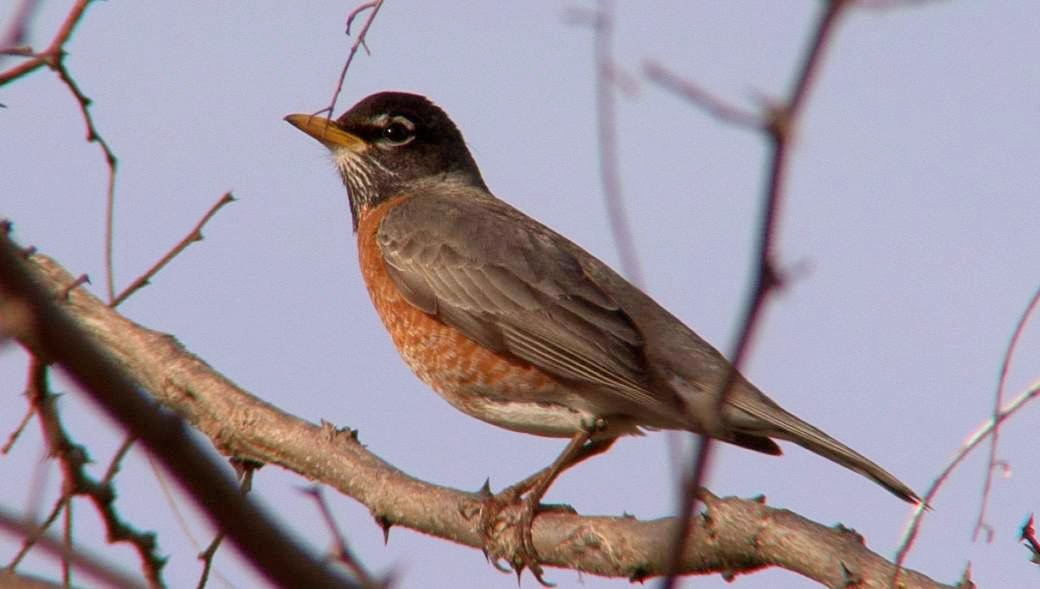
American Robins could be considered the harbingers of winter  for some folks
In the cold weather Robins switch to a diet of fruit
By November a few species of thrush can still be found in our Northeastern forests and meadows. Two of them regularly spend the colder months with us and they also happen to be the best known of the group. American Robins and Eastern Bluebirds are both members of the thrush family though their colorful plumage contrasts greatly with woodland thrushes’ more cryptic plumages. Don't try this at home, but if you painted either a Robin or a Bluebird brown you'd immediately see how much they resemble woodland thrushes. The Robin would look much like a Wood Thrush and the Bluebird would look quite a lot like a Veery.
The Eastern Bluebird is also a species that overwinters with us
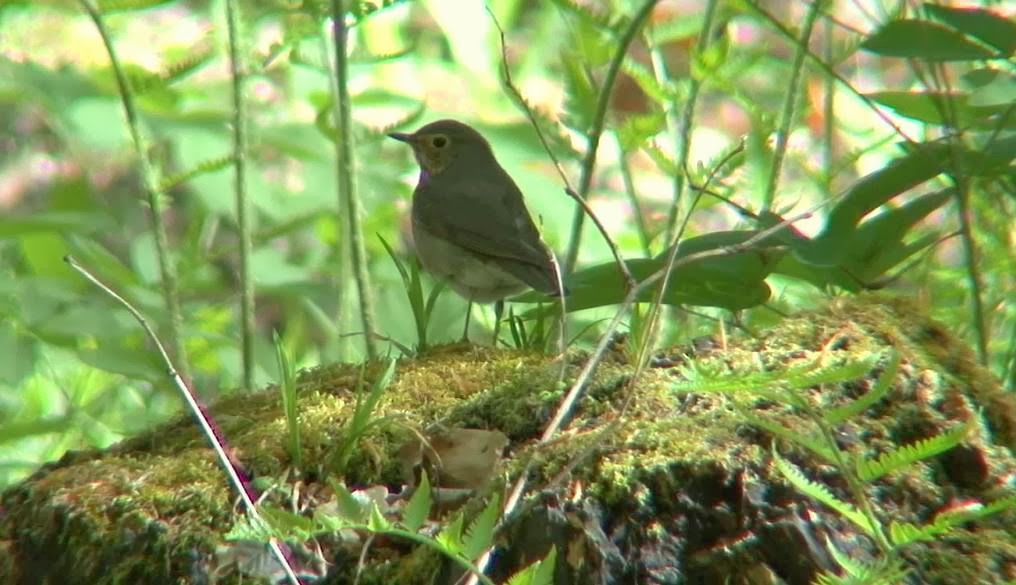
Note the similarities in body and beak shape between the Bluebird and this Veery
If you observe thrushes feeding you'd see similarities in their foraging techniques. When I see a Hermit thrush trotting across the forest floor and then abruptly stopping, cocking its head and then striking at an unseen insect or worm on the ground, I immediately think of the Robin's familiar hunting style.
On the ground the Hermit Thrush's foraging technique is much like that of the Robin 
An immature Robin is very spotted, which makes it look more like a Wood Thrush
A Wood Thrush sings in the early summer - note the heavily spotted breast
It's not unusual to have a flock of  100 or more Robins spend the entire winter at our nature preserve. Their stay is contingent on the availability of wild fruit including grapes and apples . Many birds including Robins switch over to a diet of primarily fruit in the colder months. This is understandable since insects and other invertebrates become difficult to obtain.
Robins and European Starlings feeding together on European Buckthorn Berries
Cedar Waxwings are also wintertime feeding companions of Robins
Cedar Waxwing
European Starling
Are the Robins that spend the winter with us the same individuals that breed here during the summer? Most probably not. Our summer Robins migrate south, while their Canadian Cousins arrive here from the north and essentially replace them in the habitat. To us on the ground it just looks like the Robins never left.
Robins retain similar plumage throughout the year
Any woodland thrush found at this time of year would most likely be the Hermit Thrush
Late lingering Brown Thrashers are sometimes responsible for erroneous Wood Thrush sightings
Sometimes people come across what they believe to be a Wood Thrush skulking about in the November forest. The problem being that by this time of year our Wood Thrushes have already completed their long journey to the tropics. In fact the Wood Thrush, Veery, Swainson’s Thrush and Gray-cheeked Thrush are all highly unlikely to be encountered here this late in the season. However, coming across the Hermit Thrush is actually possible. The Hermit Thrush remains longer in the northeast than its forest dwelling allies. Occasionally a few will survive the entirety of an Upstate New York Winter. Again it all depends on how adequate the wild food supply is.
A few Hermit Thrush might remain north for the entire winter season
The Brown Thrasher will sometimes be spotted as late as November or even December, and they too are sometimes mistaken for Wood Thrushes. This is understandable especially if you get only a fleeting look at the bird from the front. Both species show a light chest and belly that are covered by a dense constellation of dark spots. Upon getting a better look, the Thrasher’s long bill, yellow eyes and long tail are distinctive enough to prevent it from being confused with a true thrush.
Swainson's Thrush, like the Wood Thrush and Veery are never found here in winter
A young Bluebird perches on one of Spring Farm's Windmill towers
In November and generally throughout the winter, Bluebirds can be found but they are more elusive than Robins. Normally small flocks consisting of one or 2 family groups band together. Occasionally they can be found mingled in with larger mixed flocks of Robins, Cedar Waxwings and Starlings, but more often they are by themselves and away from the bustling feathered crowds. An overgrown Meadow or an old orchard replete with fruit would be a good place to find them, but they also might be found in wooded swamps or at a beaver wetland. Perched on a powerline overlooking a farm field is another likely situation to find a Bluebird in November.

Sunday, October 27, 2013

The Fall Foliage Display Was Muted, but There Were Highlights

Silky Dogwood
For the most part the fall colors were muted in our part of the country. Tree species that turn the most vibrant colors - including the Sugar Maple and White Ash didn't stand out nearly as much as they normally do. Deep red, purple, orange, peach and copper colors were sorley lacking in the mix. Yellow was well represented, but even that color was not  up to its usual intensity. The leaves of the Hickories and Tulip Trees normally turn brilliant shades of yellow, but this year it seems as though someone really turned down their color knob.

This was about the most colorful view that I could find on the property this season
A few isolated places looked good - Maples are doing the heavy work here
Still, with most of the showier trees out of the running, trees and bushes that are not usually not so prominent seemed to stand out more. The normally subdued colors of the Black Cherry trees in our reforestation field were more pronounced this year but it's likely that this would've escaped our notice if the neighboring trees weren't so dull. Smaller trees of the forest understory, meadows and wetlands seemed to be about as colorful as they ever are. Smooth Sumac never disappoints - and this year was no exception to that rule. Silky Dogwood was just as impressive as ever with most of its leaves turning a deep purple.

It's fairly unusual for Black Cherry Trees to have such colorful leaves
Currently in the old woods it's the beech trees that are providing most of the color
The foliage of the American Beech trees range from cooper to golden
If you were doing an assessment of Oak Trees alone you'd only be half disappointed.  While most in the White Oak family are only expected to turn various shades of brown, the Red Oak group contains some more reliable showmen. This fall as usual  most all of the Pin Oaks turned bright red - though that color had little staying power and only too soon they faded into brown. The Red Oaks themselves were a mixed bag - some turned orange and/or red while others went right to brown. The White Oak and the Swamp White Oak (both in the White Oak group, but in fall they are honorary members of the Red Oak group), for the most part didn't disappoint and turned beautiful shades of burgundy.
White Oaks and Swamp White Oaks didn't disappoint us this season
Most Aspens turn yellow - but these orange leaves came for the top of a Big Tooth Aspen
The leaves on this Northern Striped Maple (AKA  Moosewood) turned a ghostly pale
Our Pin Oaks turned bright red before fading quickly into brown
Virginia Creeper turned either brilliant red or purple, but most of these vines were well past their prime by the time the rest of the forest community started to get their color.
Virginia Creeper leaves change color very early in the season
Early in the season colorful foliage of Virginia Creeper vines outline the trunks and branches of their host trees
It's not just foliage that's colorful - as exemplified by the spent flowers of Buttonbush 
The stems and foliage of the Indian Hemp plant can be very colorful in late summer
As a reaction to freezing temperatures red  bittersweet berries emerge from their yellow sheaths