Sunday, June 2, 2013

Calling All Cuckoos - The Gypsy Moths are Here

Yellow-billed Cuckoo reporting for duty
In late winter I started finding egg masses from Gypsy Moths on some of our reforestation trees. The beige colored masses were found on a variety of the young trees, but they were mainly found on Oak Trees. I was removing the masses as I saw them, but what I didn't realize was that there were many more hidden inside the plastic tree protectors that we use on some of the young oaks. The eggs are not thought to survive temperatures below 20 degrees Fahrenheit and during the winter we did have some days well below that temperature, but evidently, there inside the tree protectors, the egg masses were sufficiently insulated from the cold and the eggs managed to survive.
After the tree protector is pulled away, we find the egg masses
Among the eggs masses are the remains of the moths pupa 
 In the first days of May, just as the leaf buds were beginning to break, the concealed eggs began to hatching and the earliest instar of the Gypsy Moth larvae gathered in tight groups on the tree bark. Soon enough they began making their first forays into the higher branches to munch on the newly unfurled leaves. 
The young caterpillars feeding on Oak leaves
A young Gypsy Moth caterpillar on the underside of a Pin Oak leaf
We have had similar outbreaks in the past involving Forest Tent Caterpillars and Eastern Tent Caterpillars - two highly accomplished "defoliaters" of deciduous trees, but we've never had the Gypsy Moth show up like this before. Of course we've never had so many oaks to attract them either. Unlike the tent caterpillars, the Gypsy Moth is an imported species.
As a humane, organic and pesticide-free nature preserve (the only way to be if you want to safeguard your birds and insects), removing egg masses is about as far as I will go to directly combat these moths. My real hope is to enlist the assistance of 2 resident cuckoo species that have a well-known penchant for feeding on hairy caterpillars. In fact the Black-billed Cuckoo and the Yellow-billed Cuckoo are known for deliberately seeking out infestations of these caterpillars and then nesting in that vicinity.
The Black-billed Cuckoo has a red ring of bare skin around its eyes
The Yellow-billed Cuckoo has a distinctive yellow bill and lacks the red eye ring
Most songbird species - even the seed and fruit eaters, switch to a high protein diet of insects during the breeding season. Certainly much of what they feed their nestlings consists of the larvae from a wide variety of insect species. What most birds avoid though are the hairy caterpillars. The hairs of the caterpillars irritate the digestive tracts of most birds and are therefore usually avoided by all except the cuckoos. The cuckoos have evolved digestive systems that can cope with the hairs of these caterpillars.
Black-billed Cuckoo with a hairy tent caterpillar 
An aggressive Yellow-billed Cuckoo defends its nest area
At the preserve, I've had some experience with both cuckoo species and have even found a few of their nests. For breeding, the Black-billed seems to prefer overgrown meadows and orchard type habitat, while the Yellow-billed prefers more heavily wooded areas. Their nests are very similar - they are shallow, disk like structures made primarily from long twigs. They actually look pretty flimsy and so it's probably a good thing that the female only lays one or 2 eggs.
The Yellow-billed Cuckoo's nest is a bit like a colander made of sticks
The Black-billed Cuckoo sits on her nest
The Yellow-billed seemed to be more aggressive in defending their nest site. Before I even knew there was a nest, I was accosted by one of the frantic patents which proceeded to put on quite a show in front of me - pivoting back and forth with its long spotted tail, diving from branch to branch and occasionally stopping to give its “tapping on wood” type call, which I have to say – as an alarm call, it’s rather on the subtle side.
The tail of the Yellow-billed is characterized by large white spots
The Black-billed Cuckoo's white tail spots are much less prominent 
Over a century ago, John Bartlett Wicks (1836-1915), a local naturalist writer, compared the posture of our cuckoos and the way they moved through tree branches to Passenger Pigeons – a long extinct bird species that Wicks had extensive experience with during his lifetime. The Passenger Pigeons were of a similar size and shape to the cuckoos – and they also shared the behavior of laying only 1 or 2 eggs each season.
A young Black-billed Cuckoo nestlings waits to be fed
An immature Black-billed Cuckoo - its eye ring isn't quite that red yet

A few more pictures from around the nature preserve:


American Mountain Ash bloom at the edge of a reforestation field
White Baneberry blooms in the old woods
Silvery Blue Butterfly
Pearl Crescent Butterfly

Sunday, May 26, 2013

Amphibians, Foxes, Butterflies and a Very Strange Gall - Also Some of the Latest Blooms

A happy American Toad joins the singing chorus at his favorite pond
The extended period of dry weather looked to be bad news for some of the preserve’s amphibians – particularly the ones that rely on our vernal pond. That small woodland pond had shrunk to about the size of a puddle and the Wood Frog tadpoles were crowded together in a last ditch effort to survive. These little guys had just barely begun developing back legs and were clearly not capable of surviving outside of water. One more day of hot dry weather would've sealed their fate, but the rains came just in the nick of time and most of them were saved. As of yesterday this pond was filled to the brim again.
Mating can be a pretty  raucous affair with Toads

American Toad tadpoles gather in the shallows
The American Toads are partial to breeding in another pond – fortunately one which isn't so reliant on rainfall for maintaining its levels. Last year an early spring warm spell effectively scuttles the toads' breeding season. I recall that the toads had begun converging at the pond a full month earlier than usual, but then more seasonable (cold) temperatures returned and that abruptly halted their breeding activities. Consequently few eggs hatched and toad tadpoles were scarce  By contrast this year a quick survey of the pond's shallows revealed thousands of tiny toad tadpoles swimming in the shallows. They appear to be more than making up for last years losses.
Red-spotted Salamander or "Red Eft" moves slowly through the forest
Lately the Efts are very common in the old woods
Red-spotted salamanders were also in the same pond where presumably they too are spawning. More notable has been the number of them encountered in the woods. Clearly they've been taking advantage of the recent rains to disperse into their woodland habitat. Of all the salamanders, the Red-spotted or Red Efts are by far the most commonly encountered in our region. Unfortunately they have a tendency of lingering on the foot paths and they are not good about getting out of the way of foot traffic. Lately when I take those paths I need to really concentrate on the ground before me – to avoid stepping on them.
The Salamander returns to the pond to spawn - they look quite different at this stage
The male Red-spotted Salamander grasps the female to make sure that she doesn't  mate with another
Butterflies have been showing up in various different habitats. The other day, Hobomock Skipper and Juveniles Duskywing where seen in one of the meadows for the first time this year. Baltimore Checkerspot caterpillars were also found in our iris meadow. All of the checkerspot larva were feeding on the young turtlehead plants that grow among the irises. Like many butterflies, the Checkerspots over-winter in their larval form. They wake up in the spring, just in time for their main food-plant to appear.
The Hobomok Skipper is usually the first skipper butterfly to emerge in the spring
Baltimore Checkerspot Butterfly caterpillar
The adult Baltimore Checkerspot Butterfly
Other butterfly newcomers have been the Eastern Tiger Swallowtail, Pearl Crescent and Questionmark. For the Tiger Swallowtail the nature preserve has become a much more welcoming place since we've included that species’ main food-plants in our reforestation fields. Of course, Tulip Trees and Black Cherry Trees have other reasons for being in those fields, but the fact that their leaves can be utilized these magnificent insects is a great bonus.
Eastern Tiger Swallowtail butterfly
Pearl Crescent - another recent butterfly
At both the preserve’s bird feeders and at our house's feeders we've had female Gray Foxes coming around every day to partake of corn and peanuts. Due to the frequency of her visits, we think its likely that our yard fox has a den nearby. It has been fascinating to watch her interactions with the other wildlife in the yard. Hen Turkeys, which also likely have their own nests hidden in the nearby woods, often walk by the fox while she’s feeding. Obviously these birds don’t consider the Gray Fox to be such a great threat, but that will change once the turkeys have clutches of chicks to watch over.
A Gray Fox stands in our large bird-feeder at the nature preserve
Lately this is typical scene in our backyard - turkey and fox coexisting
Galls of various shapes and sizes have been showing up on a variety of different plants and trees around the preserve. Many of them show up on oak tree leaves and are caused by insects – primarily wasps. However, the strange orange galls that I found the other day were on Red Cedar trees and they are caused by a fungus. During its different generations, Fungal Apple Rust alternately infects Red Cedar and apple trees. The bright orange galls that develop on the cedars have spore baring tentacles, which make it resemble some exotic sea creature. The spores produced in the tentacles will next infect apple trees.


Fungal Apple Rust looks like a sea creature when its on Red Cedar

The procession of blooming plants continues at the nature preserve. Here's a sample of what we've been seeing:

Woodland Geranium 
Yellow Ladyslipper
Blue-eyed Grass - a member of the iris family
Dwarf Delphinium
May Apple
Goldenseal
Apple Blossom
Hawthorn Blossom

Sunday, May 19, 2013

Woodcock, Teal, Turtles and Other Recent Sightings


The American Woodcock calls on the ground before his aerial flight display
 The American Woodcocks began courtship display flights in late March and they have continued right up until this week. Over the last decade the breeding grounds at the nature preserve have expanded for this species as fields have grown in and become brushy meadow and young forest habitat. The beavers have done their part to keep the Woodcocks' favorite field at a stage where it remains viable breeding habitat; as they continue to harvest  larger pioneer saplings, they keep much of the field in a perpetual brushy state, which the woodcocks can utilize.
As he calls on the ground, the Woodcock turns in a circle in order to address the entire meadow
The "chunky" American Woodcock is probably our most bizarre looking shorebird
At dusk the Woodcocks begin to assemble on their staging grounds. Loud nasal "peent" calls begin to emanate from the meadow - and that's usually the first indication that the birds are there, that is unless you're lucky enough to see them fly in. The calls from a single individual vary in volume; this is because the male is turning to face different directions as he calls. After a while, as he continues to turn in place, he begins to flash his tail feathers - revealing white under-tail spots that are normally invisible on the resting bird. When it's dark enough the male launches from the ground, quickly gains altitude and begins to describe a wide circle over the meadow. In the quickly fading light, it is usually possible to pick out his silhouette against the sky. His relatively slow fluttering flight reminds me of a fat bat, or even a huge moth. Often enough, you won't be able to see him - you'll only hear the twittering sound that is produced by his outer primary wing feathers as moving air makes them vibrate.
Pictured against a darkening sky, the Woodcock may fly as high as 300 yards
At the crescendo of his flight display the male woodcock begins banking from side to side, and this creates a weaving or zig-zagging flight pattern. At this point he begins to descend and the twittering wing sound is augmented by some repetitive piping vocalizations. The flight display ends with the bird’s rapid descent to the ground and then, almost immediately, he resumes giving nasal “peent” calls. With any luck, a female woodcock had been observing this spectacle and was duly impressed.
Sitting on her nest at the base of an Aspen tree, the female woodcock relies on her camouflage 
Large eyes  placed high on her head allow the woodcock to see directly behind her
Apparently at least one female was captivated by the male's performance, because a week ago I found a female woodcock sitting on a nest in a nearby meadow. The woodcock’s excellent camouflage makes them just about impossible to pick out against the surrounding vegetation. The birds’ relatively large eggs are brownish and heavily blotched with dark spots so they too blend in with their surroundings, which is an important safeguard for whenever the female has to leave the nest in order to feed.
A Pair of Blue-winged Teal - the male shows a crescent moon on the side of his face

At one of our beaver ponds it looked for a little while like pair of Blue-winged Teal were going to nest. They spent over a week at the location and courtship and mating behavior was witnessed. The Blue-winged Teal is a very small duck – about half the size of a Mallard. They do nest in the region but they are by no means common here. The shoulder portion of the leading edge of their wings are light blue and that gives the species its common name. The Blue-winged Teal is sometimes a long distance migrant, wintering as far south as South America.
This Painted Turtle laid her eggs in a chicken coop!
2 painted Turtles bask in the morning sun
Lately turtles have been very much in evidence at the nature preserve. In a few cases, some female Painted Turtles have been traveling far away from their wetland habitat in order to find suitable places to lay their eggs. However, sometimes these turtles find the most inappropriate places to lay. At her own home, one of Spring Farm CARES’ employees found a Painted Turtle in the midst of laying its eggs in a hole that it excavated inside of a chicken coop. It’s likely that the resident chicken will be surprised when baby turtles start to emerge from the ground. The mother turtle was brought to the preserve for release. She joins a healthy population of Paints and other turtles at our turtle/frog pond.
Red Baneberry
Woodland Wildflowers continue to bloom around the nature preserve, though the ongoing dry weather and near constant browsing by deer have presented a great challenge to most of them.
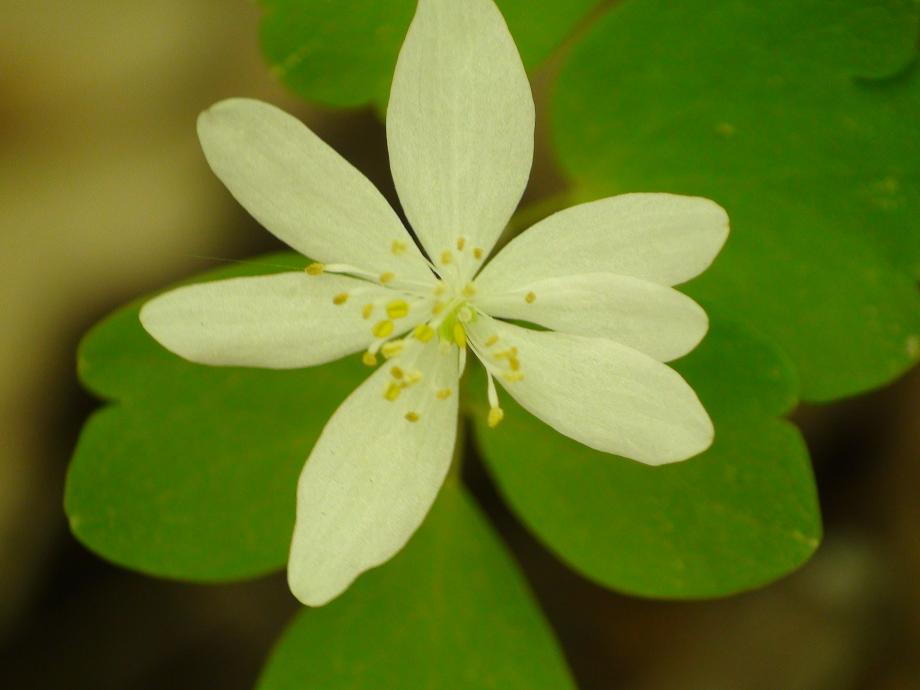
Rue Anemone
Long-spurred Violet
Canada Violet
Marsh Marigold
False Bishop's Cap
Jack-in-the-Pulpit