Sunday, January 5, 2014

Snowy Owls Invade the Region and Coyote Hunters Blight the Wilderness

This year Snowy Owls are showing up all around the Northeast
This winter the Northeast is seeing an extraordinary influx of Snowy Owls - arguably the best one in years. We keep hoping to get one of these majestic birds at our nature preserve, but so far none have been seen. Still, the winter is young and we have at least until March before the Snowys begin returning to the Arctic. Fortunately there have been a few Snowy Owls showing up in the hills of Paris, just a couple of miles South of us. I’ve seen 2 of them myself, but they were pretty distant.
 
This high field just beyond our south border needs a Snowy Owl
Looking for a Snowy Owl? Well here's an immature Bald Eagle
Last Sunday my partner and I decided to travel over to Herkimer County and to some traditionally good Snowy Owl habitat. The agricultural fields in that area are particularly high in elevation. Those large open fields provide owls and other raptors with good mouse hunting opportunities. The view from these hills is pretty impressive; you can see much of the Mohawk valley to the south and even some of the Adirondack Mountains to the north. The first Raptor that we came across was a juvenile Bald Eagle. It was on the ground and feeding – presumably on a deer carcass. It easily dwarfed a nearby group of crows that were anxiously awaiting their chance to feed. This is not such an unusual sight in recent years. Bald Eagles now can be found in our region throughout the year and often quite far from rivers and lakes. We had a young Bald Eagle spend the entire day at the nature preserve just this week and we’re quite far from any river.
 
Still looking for those owls? Well take this male American Kestrel
Is that a rock or an old tree stump?
Hey, that rock has a white face
Our next Raptor was a Rough-legged Hawk. We ultimately found 3 of these rather hefty-looking hawks. Like the Snowy Owl, in winter the Rough-legged Hawks travel down from the far north only when the northern rodent populations crash and when the hunting is poor. Our next find was a beautiful male Kestrel that was sitting on a telephone line, but we were still finding no Snowy Owls.  We had a limited time to pursue this venture; in fact we were just about to give up when we decided to try one more road. Sure enough, in the middle of a snow covered field was a mostly dark immature Snowy Owl. The bird was hunkered down on the ground and its charcoal color made it look a lot like a rock. Only the owl’s face was white. While we observed this owl it was briefly harassed by a female Northern Harrier, which dove down on it several times before finally calling off its attack and sailing off to the south. Most Harriers do not spend the winter this far north, neither for that matter do many kestrels, but intensive searching or luck can lead you to a few individuals just about every winter season.

The Northern Harrier repeatedly dove at the owl
The White rump patch on the Harrier is a good identification mark
A little more driving led us to a 2nd Snowy Owl. This one was much Whiter and was conveniently perched on top of a utility pole. We didn't get too close so as not to disturb the bird, but our binoculars allowed us to see the finer details of its plumage. In the old days we would've confidently declared such a white individual to be an adult male, but now studies have concluded that adult females can also sometimes appear as nearly pure white.
When not perched on the ground, Snowy Owls like fence posts and utility poles

This would have been a great trip had it not been for the fact that a coyote extermination project was underway in those beautiful hills. Groups of hunters – many with their hound dogs in tow, were pushing into different fields and brushy areas and trying drive coyotes into the open where they could be shot. Other hunters were seen parked in various places along the road side, lying in wait in case the coyotes came their way. It was pretty horrible. And what’s more horrible is that it’s apparently legal to do this in New York State.
 
Around our way, the only deer that coyotes feed on are those that hunters leave behind
Coyotes do most of their feeding after dark. Remaining unseen by people is a necessary survival technique
Why are they trying to exterminate coyotes? Probably because they think that the coyotes are somehow depriving them (the hunters) of deer that they themselves want to kill. Of course, for the most part the only deer that coyotes feed on are roadkill deer and on deer that hunters shoot, wound and then fail to track. If that wasn't the case, then naturalists like me would be coming upon plenty of coyote-killed deer carcasses in the woods – throughout the year, but we never do. The truth is that coyotes feed primarily on rodents, other small creatures, carrion and on plant-based foods.
 
Returning to the old site of a deer carcass which is covered by snow

With their heavy winter coats, the Coyotes look more wolf-like
Coyotes don't all look the same. This individual is more golden than most


Extermination campaigns like this are reminiscent of those that took place 2 centuries ago, when the pioneers of our area systematically worked to kill off every large (and even most of the not-so-large) predators in our forests. In a relatively short time they successfully eliminated all of our Wolves, Cougars, Bobcats and Black Bears. The result of this was a hopelessly out of balance ecosystem, which remains out-of-balance to this day. It’s important to realize that these coyote hunters are the same folks  that justify deer hunting in large part as a method of managing the size of deer populations. Keep in mind that when ever a predator that is even remotely capable of taking down a deer shows up, they want it gone. 

When coyotes rip into a carcass they make it more accessible to many other scavengers, like these crows


Sunday, December 29, 2013

Some Winter Wildlife from the Nature Preserve

This buck was photographed the day after the last deer hunting season ended
I don't have time to write a proper blog this week, but I still wanted to share some photos of winter wildlife at the nature preserve. 

A Carolina Wren perches in a bush near the bird feeders.


A Great Blue Heron tries to eke out a living at the mostly frozen beaver ponds
There are actually 2 Raccoons sleeping in this tree cavity
Golden-crowned Kinglets are commonly encountered this winter
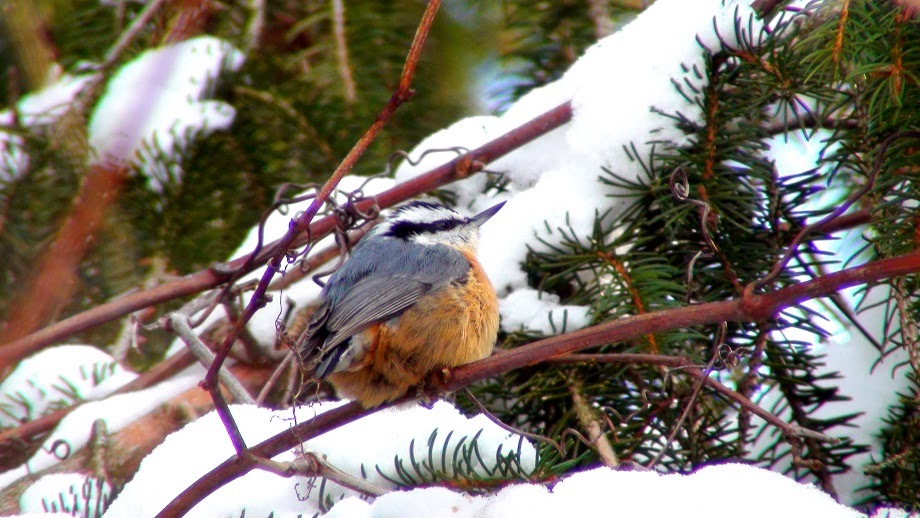
This Red-breasted Nuthatch greets me at the entrance to the preserve each day
One of the yearling beavers leans onto the ice in order to break it
A Pileated Woodpecker feasts on a carpenter ant colony in the heart of a dead tree
A Downy Woodpecker looks out from the tree cavity where it will spend the night
Female Cardinal 
Gray Squirrel
Eastern Cottontail Rabbit
Muskrats in conference 
One of many White-throated Sparrows that are spending the winter with us
Tippy the Beaver
The beavers cut themselves a Christmas Tree this year. They almost never cut down evergreens
Brown-headed Cowbirds are not unusual winter visitors
Blue Jays are very common this winter

Tuesday, December 17, 2013

Deer Hunting Season Ends and Leaves us With Many Carcasses


After nearly 80 days, the last of the deer hunting seasons comes to an end this week – at least in our region. Even though hunting is not allowed at the nature preserve, every year we have the misfortune of getting a number of wounded deer onto the property. Astoundingly, most of these are not tracked by the hunters that shot them. Instead they are left to die of their wounds. Sometimes it takes hours - sometimes days or even weeks. One buck that was shot with an arrow took about 6 days to die. The day after it was shot (it was shot just after dark!) I was able to track it for about a mile, but I couldn't find it. Finally I did come upon it lying dead in one of our creeks.
In fall most bucks walk around oblivious to all but the scent trail of a doe
A doe lays down for the night - often they get covered with sonw
I don’t think that inflicting an agonizing death on these animals is the aim of most deer hunters, but too often it is the result. Many hunters seem to lack both the ability to hit their target in the right place and the ethical sense to realize that merely wounding an animal is an unacceptable outcome.
A buck approaches his fallen comrade

A Red tailed Hawk often claims the carcass for most of the day
The only silver lining to these sad cases is that the animals that die will never go to waste. Legions of scavengers will use them to sustain themselves through the most difficult time of the year. Interestingly, it’s not just the usual suspects – the coyotes, foxes and Red-tailed Hawks, which visit deer carcasses. Even songbirds occasionally come for a small share. Most surprisingly of all, I've seen mice including the tiny Northern Jumping Mouse coming to feed on a carcass. 
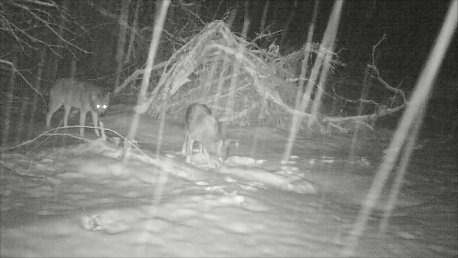
The male of a pair of Coyotes that visited this carcass
The female Coyote 
Regulars to one deer carcass included a pair of Coyotes and a pair of Gray Foxes. The foxes would usually visit in the evening while the coyotes would wait until the early morning hours. Red-tailed Hawks seemed to be the most common day time scavengers. Unlike the others, the hawks will often remain at the site for many consecutive hours – fending off crows and anything else that may have a taste for carrion.
The Gray foxes were the most common nighttime visitors to the carcass

Just lately there’s been a new deer carcass right beyond our border at the top of a wooded hill. There scores of crows have been assembling every morning and late last week a group of 8 Ravens joined them. While a large flock of crows doesn't normally tolerate a single raven in their midst – especially when there’s food around, apparently when there are as many as 8 to contend with the crows reluctantly take the path of peaceful coexistence.  
The Fisher's large feet , no doubt help them to run on top of the snow
The Fisher visits the site in the early morning hours
Yesterday at that same carcass site there was an adult Bald Eagle. When I came through she took off from her perch in a large tree and started to fly toward the south. Bald Eagles and Golden Eagles are known to visit deer carcasses – particularly when they are in open areas. When most of the region’s bodies of water are frozen over and fishing becomes less of an option, the Bald Eagle sees no shame in acting like a vulture.

An adult Bald Eagle was seen perching in the trees above another deer carcass
Other than the occasional set of tracks, we had been seeing little action from of our resident Fishers since the spring. That seems to have changed just lately and now I’m starting to find Fisher tracks all around the preserve and in just about every type of habitat. They don’t seem to be making a habit of visiting the deer carcasses – at least the ones that I've been keeping track of, but I expect they will at some point. Probably once their rodent prey becomes harder to come by.

Monday, December 9, 2013

The Annual Christmas Bird Count


The Barred Owl can be found throughout the winter
Of all the possible times of year to choose from, why conduct a bird census in December? That’s the most common question people ask when they hear about the Christmas Bird Count. In December, and in wintertime in general, there are the fewest number of bird species to be found in the Northeast. Yet, this is when approximately 30 Mohawk Valley residents brave the cold to participate in the National Audubon Society's Annual Chistmas Bird Count. Once all of our individual field sheets are tallied, we can expect to confirm between 50 and 60 bird species in the greater Utica area. That's not bad considering that any one of us during the course of a normal winter day might expect to find no more than 10 species in our own yards.
The female Northern Cardinal  - a bird for all seasons
Most Northern Flickers head south, but a few will remain each winter 
The Christmas Bird Count is the longest running bird census in North American. It began in the year 1900 and was conceived by ornithologist Frank Chapman as a protest against the once popular Christmas wildlife shoot (called a Side Hunt) that used to take place annually on Christmas Day. The object of Side Hunts was for teams of hunters to go out in the field and shoot as many birds and small animals as they could find. Each animal was assigned a certain number of points and the team with the most points at the end of the day was declared the winner. Unfortunately, birds and other animals were the guaranteed losers in these events. It’s important to understand that this was happening at a time before strong Federal laws protected our native birds. Such an event would be illegal if it were to be held today.
The most numerous bird found on last year’s count was the Snow Goose
Blue Jays are one of the staple birds our local count
Before the Federal Migratory Bird Treaty act went into effect in 1918, many North American bird species appeared to be headed toward extinction. Some, like the Passenger Pigeon and the Carolina Parakeet, had already gone extinct.  Side hunts were by no means the main cause of the declines; a whole range of pressures from market hunting to habitat loss to egg and specimen collecting all took their toll. One of the greatest single threats came from the Plume Trade. Between 1880 and 1920, decorating women’s fancy hats with elegant bird feathers was a fashion imperative that frequently drove Plume hunters to decimate entire nesting colonies of Egrets, Terns and other species in search of beautiful feathers.
The Sharp-shinned Hawk preys on winter songbirds
In the beginning, very few people participated in the Christmas Bird Count and in only a few places, mostly in the Northeastern US. Over the course of many decades its popularity grew exponentially.  Today, tens of thousands of birdwatchers participate in 2,300 counts that take place all over North America. The census data that is collected is useful because it gives scientists a snapshot of where birds are at a specific time of year. By comparing results across multiple years, they can draw conclusions about how species and specific populations are changing over time. 
The Tree Sparrow is our quintessential winter sparrow

Where there is open water you may find Hooded Mergansers
The protocol for counting birds is the same whether you are in Alaska or in Mexico; participants are tasked with counting every bird they see on a single pre-determined date. Most counts take place from dawn to dusk but nighttime birding, in the form of “owling”, is also encouraged. All bird counters must stay within a designated count circle that is 15 miles in diameter. For the Clinton/Utica Bird Count, the center of our circle is roughly where Jay-K Lumber is located on Seneca Turnpike in New Hartford. Our circle contains a diverse range of habitats, everything from forestland to agricultural fields and from marshes to city streets. Each distinct habitat type has the potential to harbor different kinds of birds.
If there is open water, some Wood Ducks may be found
Over the 40 years that the Clinton/Utica Christmas Bird Count has been taking place, we have seen some significant changes in the bird life of the Mohawk Valley. Probably the most notable change has been the number of waterfowl that are now regularly found lingering here into mid-December. That trend began in the 1990s and has become more dramatic as the years have progressed. A species like the Snow Goose that was never encountered in our count circle until the year 2000 was the most numerous bird species tallied in our most recent count. Last year, close to 70,000 of them were seen in area cornfields and flying overhead. Warmer temperatures in December are enabling these geese to migrate later in the season than before. Canada Geese and a variety of ducks are now expected to be found since open water and snow-free farm fields often remain available through at least mid-December.
The House Finch was once one of our most common winter birds
Local Christmas Bird Count data tracks significant changes in the populations of some our common backyard songbirds. For example, the House Finch never occurred in Central New York until the 1970’s after which their numbers gradually increased and finally hit a peak in the early ‘90s. Following that, their numbers crashed. The drop in population was the result of a form of conjunctivitis (an eye disease) that proved deadly to the birds. The disease spread like wildfire in this highly social species that commonly feeds together in flocks. After the 1990’s, modest numbers of House Finches continued to be tallied on our bird counts but their numbers never again reached their former highs. To this day, the disease remains a limiting factor in their population. 
Once rare, the Red-bellied Woodpecker is now quite common
Once common, now the Red-headed Woodpecker is rarely seen locally
The Red-bellied Woodpecker is a species that was never found in our count circle until 1980, when a single bird was located.  In contrast, we regularly see as many as 30 of them now, which makes them as common as any other of the regularly occurring winter woodpeckers. This change can be explained by the regrowth of forests in our region.   The Red-bellied Woodpecker is a forest nesting species that benefits greatly when agricultural fields give way to woodlands. The increasing popularity of maintaining well stocked bird feeders has also benefited the Red-bellied Woodpecker, since they are quick to utilize those resources.
The fortunes of the Red-headed Woodpecker are quite different than those of its Red-bellied cousin. Once, the Red-heads were a common species in the Mohawk Valley, but by the time the Clinton/Utica Christmas Bird Count got started in 1974, the species was already on its way out. Still, individuals and small groups continued to be found within our count circle until 1990. The reasons for the Red-headed Woodpecker’s decline are not fully understood, but it is thought that the same alteration in the region’s habitat that benefited the Red-bellied Woodpecker was a disadvantage to the Red-head, which requires more open land in order to thrive.